



If you searched for TVCs meaning, the short answer is straightforward: TVCs are television commercials, paid video advertisements created to promote a brand, product, service, person, or idea.
For a marketing team, though, the acronym is the easy part.
The more important question is what the commercial needs to make someone understand, remember, or do. A 15-second launch spot and a 60-second brand video may both be called TVCs, but they create very different production problems.
That is why we would not begin with runtime or visual style alone. We would begin with the communication job.

What Does TVC Mean in a Modern Campaign?
Traditionally, a TVC refers to a television commercial produced for paid broadcast.
Today, the same master commercial may also need to work across connected TV, online video, social placements, campaign landing pages, events, or regional cutdowns.
That wider distribution is one reason modern video marketing planning should happen alongside production rather than after the master commercial has already been delivered.
The TVC may still be the hero asset, but it often sits inside a broader marketing campaign containing shorter edits, social versions, landing-page assets and other placements.
That does not mean every version should be identical.
A television placement may give the story more room to establish itself. A short video ad may need the product, brand or visual hook to appear much earlier. Vertical social media may also require a different crop, typography treatment, or end card.
Thinking about each placement as an advertising medium helps clarify why the same idea may need different execution rules depending on where people encounter it.
So while TVCs meaning begins with “television commercials”, the production conversation now often includes a wider family of campaign assets. The important thing is to decide that family before production starts.
Start With the Job of the Commercial
A TVC can be asked to do several things:
- build awareness;
- introduce a product;
- create preference;
- explain a service;
- change perception;
- prompt a specific action.
The problem begins when a short commercial is expected to do all of them equally.
Most briefs contain more information than the audience can realistically absorb. Product teams want features included. Marketing wants differentiation. Brand teams want the campaign idea to breathe. Legal may need qualifying language.
All of those requirements are valid, but the commercial still needs a hierarchy.
Before we discuss shots or animation styles, we would ask:
If viewers remember only one thing after the commercial ends, what should it be?
That answer should influence everything that follows.
For a major launch, it can also help to separate the commercial itself from the wider set of new product launch ideas. The TVC should have one clear communication role rather than carrying every launch message by itself.

Runtime Should Follow the Message
Runtime affects more than media cost. It changes how much information each shot can carry and how quickly the audience has to process it.
Shorter TVCs work best with one dominant idea
A short commercial has very little room for competing claims.
A product shot needs enough time to register. Typography needs to remain visible long enough to read. If a key idea only becomes clear after a second viewing, the sequence may be carrying too much.
If the product itself needs to be demonstrated rather than simply introduced, a dedicated product video may sometimes do that job more clearly than forcing detailed functionality into a short TVC.
For shorter runtimes, one clear visual idea often performs a more useful job than several half-explained messages.
Longer runtimes need to earn the extra time
A longer TVC can create room for emotional build-up, context, demonstrations or a more developed narrative.
But more seconds do not automatically produce more impact.
Each additional scene should advance the argument, reveal something new or deepen the audience’s reason to care. If the commercial simply repeats its message more slowly, the extra runtime is not helping.
This is why runtime should be discussed alongside the media plan and message structure, not filled in as a production detail later.
Should the TVC Use Animation, Live Action or Both?
Animation can be a powerful commercial format, but it should not be the automatic answer simply because an animation studio is producing the campaign.
The broader choice between animation and live action should start with what the audience needs to believe, understand or feel.
The right treatment depends on what needs to communicate.
Choose animation when design gives you useful control
Animation works particularly well when the idea depends on stylisation, transformation, characters, abstract concepts or visuals that would be difficult to film convincingly.
A purpose-built commercial animation also gives the production team much more control over visual exaggeration, transitions, colour and environments than a conventional shoot may allow.
It also gives the production team precise control over timing, framing, colour and emphasis.
That can be valuable when a sensitive or technical message needs to feel approachable rather than clinical.

Choose live action when reality itself is the proof
Some messages depend on a real person, environment, texture or product experience.
A testimonial may need an actual face. A hospitality campaign may depend on seeing the real location. A product claim may be more convincing when viewers can watch someone use it.
In those cases, live action may provide a kind of credibility that illustration cannot replace.
For campaigns where filmed reality is central to the idea, the requirements may be closer to broader video production than an animation-led workflow.
Consider a hybrid when each format has a different job
The choice does not always need to be binary.
Live action can establish human context while motion graphics explain something invisible, add graphic information or extend the visual world.
The production question is therefore not: Which format looks more impressive?
It is: Which format makes this particular message easier to receive?
Case Study: Eu Yan Sang’s Menstrual Monster Campaign
Our work on Eu Yan Sang Singapore’s Menstrual Monster Campaign is a useful example of format serving the message.
The campaign dealt with a wellness topic that could easily have become overly clinical or information-heavy. Instead, stylised character animation gave the subject a more relatable visual language.
For healthcare and wellness communication more broadly, healthcare animation can be especially useful when the subject needs to remain accurate without feeling visually intimidating.
That decision was not simply about making the commercial colourful.
The characters gave the audience something recognisable to follow, while designed movement allowed the campaign to control tone without relying on a literal medical treatment of the subject.
The production lesson is broader than this project.
When reviewing a proposed TVC treatment, ask what the chosen format allows the communication to do differently.
If the answer is only “it will look more creative”, the format decision may not be developed enough yet.
A stronger answer explains why the audience will understand, feel or remember the message differently because of the treatment.
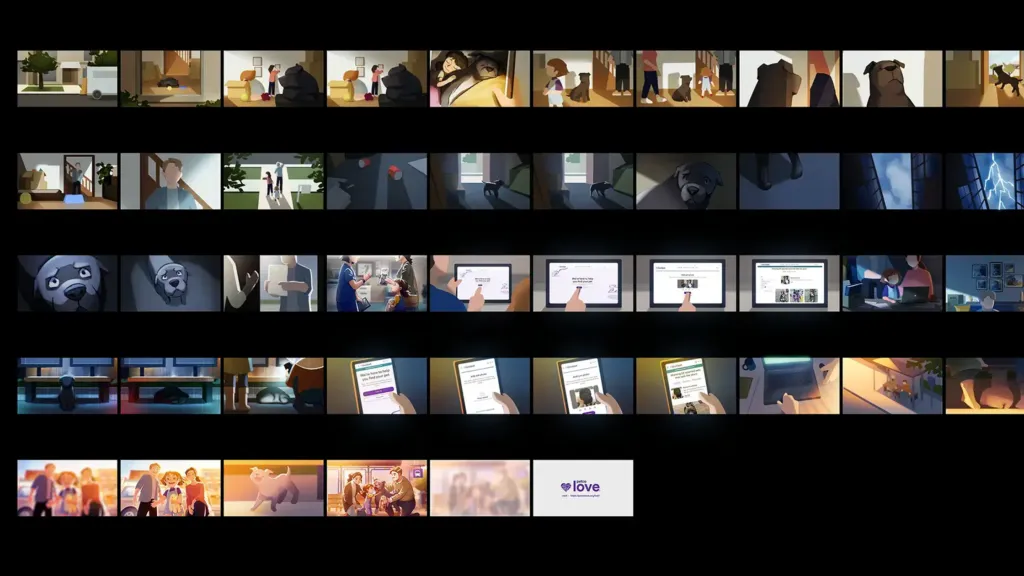
The Storyboard Is Where You Should Test the Commercial
Many buyers understandably focus on the final look.
But the animation storyboard is where some of the most important production decisions should become visible.
A good storyboard should show:
- what the viewer understands in each sequence;
- when the product or brand becomes clear;
- how one scene leads into the next;
- where text or claims appear;
- which moment carries the main message;
- how the commercial resolves into the desired action.
If your campaign includes filmed material, the same planning principle applies to a video storyboard. It lets the team test shot order and message flow before production resources are committed.
If your team has not worked through this stage before, our guide on how to storyboard an animation explains how a script or treatment becomes a sequence of planned visual beats.
If the structure is confusing in rough frames, better rendering will not solve it later.
Test whether the visual story works without explanation
One useful test is to review the storyboard without someone from the production team explaining every frame.
Does the sequence still make sense?
Voiceover can carry detail, but it should not be doing all the structural work. The images, text hierarchy and scene order should already support the argument.
This becomes especially important if the campaign will later be adapted for placements where viewers may watch without sound.
Use storyboard approval to resolve structural feedback
It is much easier to rearrange scenes, simplify a claim or remove unnecessary information during storyboarding than after detailed production begins.
That is why internal stakeholders should be involved at the right stage.
Marketing can check the argument. Brand teams can review tone. Legal can review claims. Product teams can check accuracy.
The goal is not to increase the number of reviewers. It is to resolve the right questions before animation, filming or post-production makes them more expensive to change.
Plan the Master TVC and Its Adaptations Together
A master commercial and its cutdowns should feel related, but they should not automatically be identical versions of the same edit.
A 30-second master may build context before introducing the product. A six-second cut may need the brand and visual idea almost immediately.
Social adaptations may also require:
- faster opening beats;
- larger captions;
- vertical or square framing;
- different end cards;
- shorter calls to action;
- safe areas for platform interfaces.
If social is a major part of the media plan, the requirements of social media animation should be considered before compositions are locked.
If these requirements are known early, the storyboard and composition can accommodate them.
If they appear after the master has been locked, the production team may be forced to crop important information or rebuild scenes that were never designed for another format.
An animated commercial can face exactly the same problem. A beautifully composed 16:9 master does not automatically become a strong vertical or six-second asset.
Planning adaptations early is usually both creatively cleaner and more efficient.
What Should You Check Before Commissioning a TVC?
A polished showreel is useful, but it mainly proves execution quality.
Before signing with a production partner, look at how the studio thinks about the brief.
A team offering marketing video production should be able to discuss campaign objective, audience and distribution—not only cameras, animation styles or references.
Can they explain the commercial in one clear sentence?
The studio should be able to articulate what viewers are meant to understand or remember.
If the treatment immediately jumps into references, visual effects and camera techniques without defining that argument, the project may be moving too quickly into execution.
Can they tell you what should be removed?
A useful production partner should not automatically accept every point in the brief.
Short commercial formats require prioritisation. Sometimes the most important creative decision is deciding which information belongs somewhere else.
Does the storyboard show real understanding?
Look beyond attractive frames.
Can you follow the argument? Does each scene have a purpose? Are the product, claim and brand appearing at the right moments?
This is often a better indication of communication ability than visual polish alone.
Is the approval process clear?
You should know when the script, storyboard, visual direction, animation or footage, and final edit will be approved.
A professional video production company in Singapore should make those stages and responsibilities visible before production starts.
A defined approval structure reduces the chance that a structural disagreement returns as an expensive finishing revision.
When Is a TVC Worth Commissioning?
Not every campaign needs a purpose-built commercial.
A TVC makes more sense when the campaign needs a concentrated visual story that existing assets cannot provide.
That could be:
- a major product launch;
- a new brand proposition;
- a public-awareness message;
- a campaign with significant paid-media investment;
- a message that benefits from a specific emotional or visual treatment.
A launch-focused campaign may also need an event launch video alongside the main TVC, particularly when the same idea needs to work both in media placements and in a live presentation environment.
There are also situations where it is better to wait.
If the core proposition is still changing, commissioning production too early can turn strategic uncertainty into revisions.
Likewise, if you already have an asset that communicates the message well and only need a shorter edit or platform adaptation, a completely new production may not be necessary.
The format should earn its place in the campaign.
That principle applies to creative advertising generally: an execution should serve the campaign idea, rather than becoming the idea simply because the format looks impressive.
What Should Be Included in the Brief?
You do not need every production answer before approaching a studio.
You should, however, be able to provide enough information to make the first conversation useful.
A strong starting brief includes:
- target audience;
- campaign objective;
- one primary message;
- desired audience action;
- preferred or required runtime;
- media and distribution plan;
- brand requirements;
- available product or campaign assets;
- required cutdowns or regional versions;
- launch date;
- key approval stakeholders.
From there, an experienced video production house can help determine whether the idea works best as animation, live action, mixed media or another approach.
If animation becomes the preferred route, broader animation services may include scripting, storyboarding, design, animation, sound and delivery rather than only the final movement on screen.
That is a more productive starting point than choosing the format first and asking the message to fit inside it later.
Frequently Asked Questions
Does a TVC have to air on television?
Not necessarily. Marketing teams may still use the term TVC for a master campaign commercial that is also adapted for connected TV, online video, social media or other paid placements.
How long should a TVC be?
There is no single ideal runtime. The right length depends on the message, media placement and how much story the audience genuinely needs before the campaign asks them to act.
Can one TVC be adapted into shorter cutdowns?
Yes, especially when versioning is planned during storyboarding. Shorter edits may still need different openings, crops, caption treatments or end cards rather than simply removing scenes.
What files should we request before media delivery?
Confirm the final master, agreed cutdowns, captioned or clean versions, aspect ratios, end-card variations and technical exports required by each media placement.
When should legal or compliance teams review the commercial?
Claims and regulated language should be reviewed before detailed production whenever possible. Storyboard approval is often an effective checkpoint because both the wording and its visual presentation can be assessed together.
Planning a TVC Campaign?
Start with the communication problem before choosing the production treatment.
Share your audience, campaign objective, main message, intended placements and required versions with SuperPixel. Our video production services in Singapore can help determine whether animation, live action or a hybrid approach gives the commercial the clearest form.
Explore selected SuperPixel projects or contact the team to discuss your brief.