


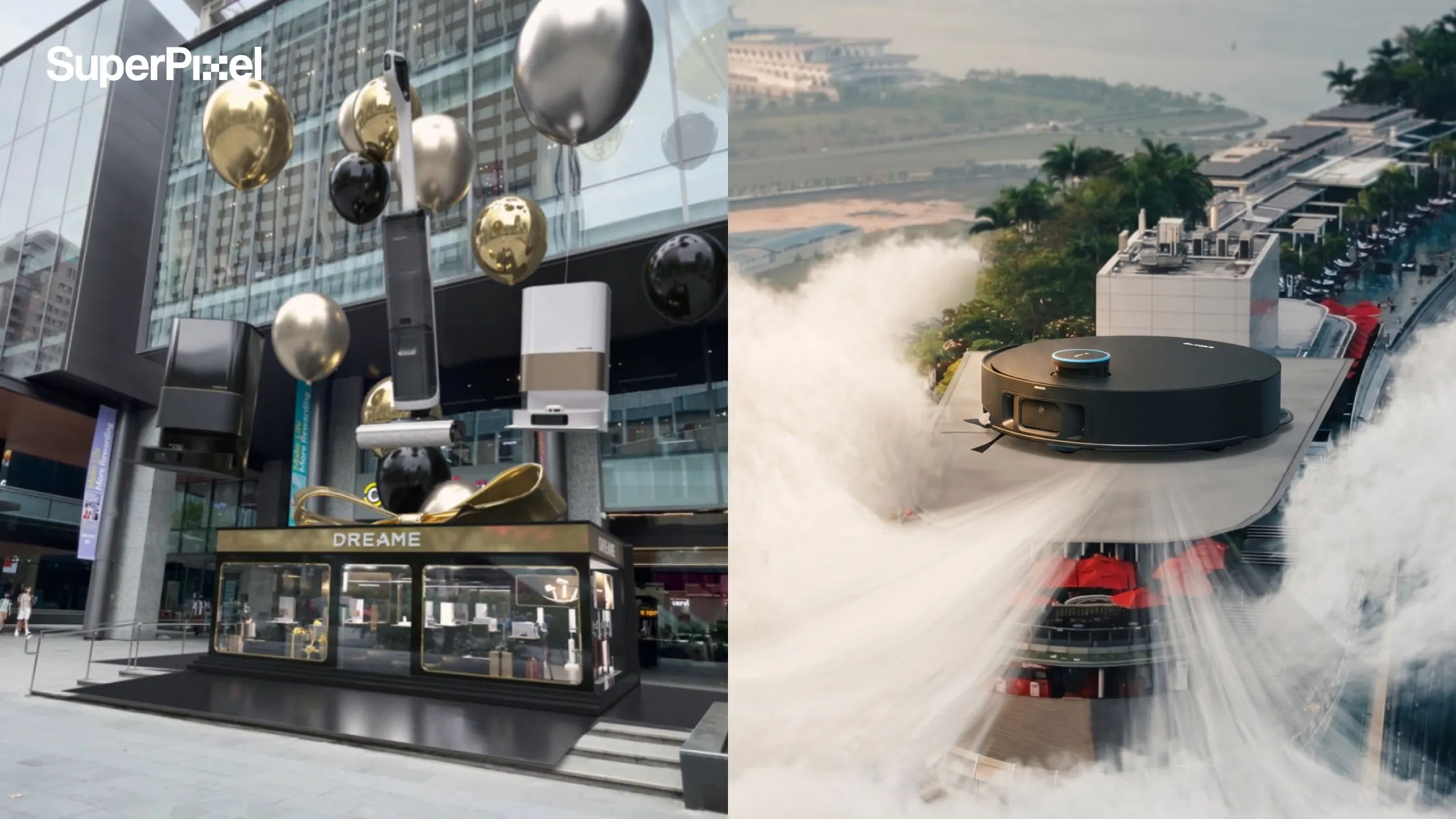
Most teams do not struggle with augmented reality OOH because the technology is too difficult to understand. The confusion usually starts earlier.
A campaign reference gets shared. Someone calls it AR. Someone else thinks it should look like a viral CGI stunt. Another person imagines an interactive public screen. By the time production begins, three different media ideas have been bundled into one brief.
The useful question is simpler: does the campaign need people to participate, or does it mainly need people to notice?
That distinction changes the location, interaction, production scope and even the way success should be measured.
For SuperPixel, augmented reality OOH earns its place when participation is part of the media idea itself. If the audience only needs a striking visual impression, another outdoor format may work harder with less friction.
Key Takeaways
- Augmented reality OOH works best when the audience has a clear reason to participate.
- AR OOH, interactive DOOH and FOOH may look similar in a campaign deck, but they ask very different things from the public.
- The location should shape the interaction before the technology is chosen.
- If the first action feels unrealistic in the actual street, mall or event environment, simplify the idea before production.
Does the Campaign Need Participation or Attention?
AR is strongest when the public is meant to do something.
They may scan a QR code, reveal an object in their surroundings, place a character into a real location, capture the result or continue exploring from their phone.
If the objective is simply to create one memorable visual moment at scale, participation may not be necessary. A strong digital OOH execution or FOOH film might achieve that goal more directly.
This sounds obvious, but it changes the budget conversation. AR is not simply another visual layer placed over outdoor advertising. You are asking a passer-by to notice an invitation, take an action, wait for a response and understand the reward.
Every additional step is part of the creative.
That is why we would define the first audience action before deciding how sophisticated the technology should become.
AR OOH, AR DOOH, Interactive DOOH and FOOH Are Different Jobs
The categories increasingly overlap visually, which is why campaign references can become confusing. A giant creature in a city street could describe four very different production models.
| Format | What the audience does | Where the experience happens | A useful reference |
| Mobile AR OOH | Scans, opens and explores | Personal phone + real location | SuperPixel — Re-Route Festival AR Monster |
| Screen-based AR / AR DOOH | Watches reality augmented on a public display | Physical OOH screen | Pepsi MAX — Unbelievable Bus Shelter |
| Interactive DOOH | Touches, gestures or triggers a shared display | Public screen / installation | Marvel — Doctor Strange |
| FOOH | Watches and shares an impossible-looking film | Primarily social/video distribution | Maybelline — Sky High |
The difference is behavioural.
Mobile AR asks people to enter the experience. Interactive DOOH asks them to act in front of a shared screen. FOOH asks them to watch and share the illusion.
None is automatically more innovative than the others. They simply buy different kinds of attention.
Pepsi MAX: when the location already supports the behaviour
The well-known Pepsi MAX Unbelievable Bus Shelter is useful because the media environment was already doing part of the interaction design.
A London bus-shelter display showed a live view of the street and composited 2D and 3D elements into it, making commuters appear to see robots, asteroids and other impossible events happening directly ahead. Grand Visual later turned footage from the activation into social content as well.
The clever part was not simply the AR effect.
People at a bus shelter were already waiting, facing the street and spending time in one position. The idea worked with an existing behaviour instead of asking commuters to learn a completely new one.
That is an important OOH principle: the site should make the first action easier, not harder.
Doctor Strange: when interaction belongs on the shared screen
Grand Visual’s Doctor Strange work demonstrates another route. Users could manipulate a live camera feed and open portals using gesture and touch interactions on a public display. The experience was deployed across multiple markets.
Nobody needed to install an app before understanding the spectacle.
That matters when shared participation is more valuable than a one-to-one mobile experience. One person can interact while everyone nearby sees what happened.
Maybelline Sky High: when the video is the media product
Maybelline’s widely shared Sky High clips took the opposite route. A London bus and Tube train appeared to wear enormous eyelashes before giant mascara wands swept across them.
The scenes looked like spectacular outdoor installations, but they were CGI-created films designed to circulate as content.
That is why FOOH can be the better answer when the real objective is broad online attention.
The physical street provides visual credibility. The audience does not need to be there.
Case Study: Re-Route Festival AR Monster on Orchard Road
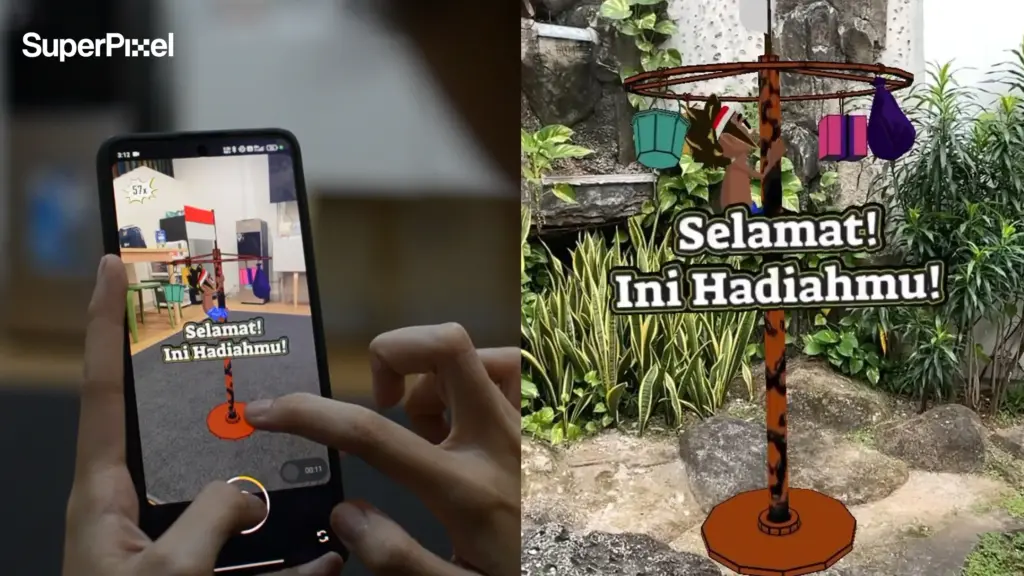
For Re-Route: Orchard during Singapore Design Week 2024, SuperPixel created two AR animations along Orchard Road for PLUS Group Singapore. Visitors accessed the experience by scanning QR codes, bringing animated monster characters into their real-world surroundings.
The location changed how we thought about the interaction.
Orchard Road is not a controlled demo room. People are walking, talking, looking at storefronts and moving between festival activities. The experience could not ask for a paragraph of instructions before giving anything back.
So the entry needed to stay light: scan first, discover second.
That decision affected more than the QR code. The character had to appear at a scale that felt convincing against the city environment. Its movement needed enough time to establish presence without delaying the payoff. Framing mattered because the audience was looking through a phone while standing in a real street, not watching a finished animation in isolation.
WebAR, Social AR or Native App?
Once AR is genuinely the right format, the next question is how people enter it.
For many one-off public campaigns, a browser-based or lightweight QR route keeps the commitment low. People can move from curiosity to experience without making an app download the first hurdle.
Social AR makes more sense when sharing inside an existing platform is central to the campaign. You gain a familiar camera and distribution behaviour, but you also accept the rules and technical limits of that platform.
A native app can support richer functionality, repeat use, accounts or deeper game logic. But that depth only matters if the audience is motivated enough to install and return.
The production question is therefore not:
Which route can do the most?
It is:
Which route asks the least from the audience while still delivering the idea?
What Actually Changes the Scope and Cost of AR OOH?
A visually simple AR experience can hide a surprisingly complex production system.
The entry method changes development and testing. A QR-to-browser experience has different requirements from a social platform or native application.
The 3D and motion scope matters too. One animated object with a simple reveal is different from a world containing several characters, states and user-triggered responses.
Then there is tracking and placement. If the digital object needs to stay convincingly anchored to a particular location, surface or marker, the environment becomes part of testing.
Analytics can also add scope. Scan counts, starts, completion, captures and sharing behaviour need to be defined before measurement gets bolted onto the experience at the end.
Finally, every public AR project needs some form of fallback thinking. Connectivity changes. Lighting changes. Permissions fail. People hold phones differently from the way the storyboard imagined.
The visible animation is only one part of what is being built.
When Augmented Reality OOH Is the Wrong Answer
One warning sign is an idea that only becomes convincing after the recap edit.
Music, cuts, reaction shots and polished social footage can make almost any activation look exciting. The street experience has to work before that film exists.
A good recap is evidence of a good activation, not a substitute for one.
AR may also be the wrong choice when participation friction is too high. If people need several instructions before anything happens, simplify the interaction or reconsider the format.
And if everyone needs to experience the same moment together, a shared public display may be more appropriate than personal-device AR. Mobile AR naturally creates a one-to-one viewing experience; interactive DOOH can make the reaction visible to the entire crowd.
The strongest production decision is sometimes choosing not to use AR.
Five Things to Lock Before Production
Before visual development becomes expensive to change, confirm the exact location and how people move through it. Define the first action you realistically expect from someone in that environment.
Then decide how they enter the experience, whether through QR, browser, social platform, app or another trigger.
Agree on what success actually means. An AR campaign may care about scans, starts, completion, dwell time, captures or shares rather than exposure alone.
Finally, decide what happens when the ideal conditions disappear. Weak signal, bright light, low participation or restricted venue access should not become surprises during launch week.
If those decisions are still vague, the animation is being asked to solve a briefing problem.
Frequently Asked Questions
Does augmented reality OOH always require an app?
No. Many public AR experiences can use browser-based or platform-based access. A native app makes more sense when the campaign requires deeper or repeat functionality.
Do AR OOH campaigns need venue or media-owner approval?
Often, yes. QR placement, physical markers, signage and other on-site elements may require approval from the venue, landlord, organiser or media owner.
What should we prepare before briefing an AR OOH studio?
Start with the location, audience behaviour, campaign message, existing brand assets, preferred entry method and launch date. Site photos, measurements and venue restrictions are especially useful.
Can AR assets be reused after the campaign?
Often, yes. 3D characters, motion assets and renders may be adapted into teaser films, social content, campaign stills or recap edits if reuse is considered during production.
How should an AR OOH campaign be measured?
Match the metric to the action. Useful measures can include scans, experience starts, completion, dwell time, captures and shares rather than relying only on estimated OOH impressions.
Planning an OOH Idea That Could Be AR, FOOH or Interactive?
Start with what people should actually do.
Send us the location, audience behaviour, campaign objective and the reference that sparked the idea. SuperPixel can help determine whether augmented reality OOH, interactive media, FOOH-style content or a simpler digital OOH route gives the campaign the clearest form.