


Holographic projection is often requested before the brief has answered a more basic question: what should the audience actually see, understand, or remember? A product launch, exhibition booth, corporate presentation, and gala stage can all benefit from a futuristic visual moment, but they do not ask for the same viewing angle, environmental control, pacing, or content structure.
At SuperPixel, we treat holographic projection as one display option within a wider spatial-content toolkit. The job is not to make every project look more technological. It is to choose a format that makes the message clearer in the room, then build the animation around the conditions people will actually experience.
That distinction matters because the phrase “holographic projection” is used loosely in commercial events. It can refer to several projection and transparent-display techniques rather than one universal system. Before production begins, the venue, sightline, content behaviour, and intended illusion need to be defined together.
When Holographic Projection Is the Right Fit
Holographic projection works best when the illusion itself contributes to the communication. It suits moments where an object, character, presenter, or visual needs to feel isolated from the background and slightly impossible: a focused product reveal, a contained exhibition feature, a premium launch moment, or a stage sequence with a controlled audience view.
The format becomes less useful when the brief is really asking for something else. If the whole room needs to transform, projection mapping may give the architecture more narrative responsibility. If the goal is long-distance visibility in a bright public space, large-format LED or anamorphic content may hold up better. If the audience needs to explore, trigger, or learn through action, an interactive installation may create more value than a passive illusion.
The practical test is simple: if removing the “holographic” effect would weaken the idea itself, the format may be doing a real job. If the idea stays exactly the same, the technology may only be decoration.
What Actually Determines Whether Holographic Projection Will Work
The quality of the 3D animation matters, but venue conditions can strengthen or flatten the effect before the audience notices any detail. That is why site planning should happen alongside visual development rather than after it.
1. Ambient light
Holographic-style displays rely on separation and contrast. Bright ambient light, uncontrolled reflections, or nearby screens can make the image feel flatter and less distinct. A concept that looks convincing against a dark preview background may behave very differently once it sits inside an exhibition hall or event space. The creative team needs to know how much light can be controlled and which parts of the visual must remain readable when it cannot.
2. Sightline and audience movement
Where people stand matters as much as what they see. Some setups work best from a clear front-facing view; others tolerate more movement. A trade-show aisle, seated gala, and retail thoroughfare create different constraints because people approach from different angles and spend different amounts of time with the content. The audience path should therefore be mapped before the visual sequence becomes too detailed.
3. Installation depth and display geometry
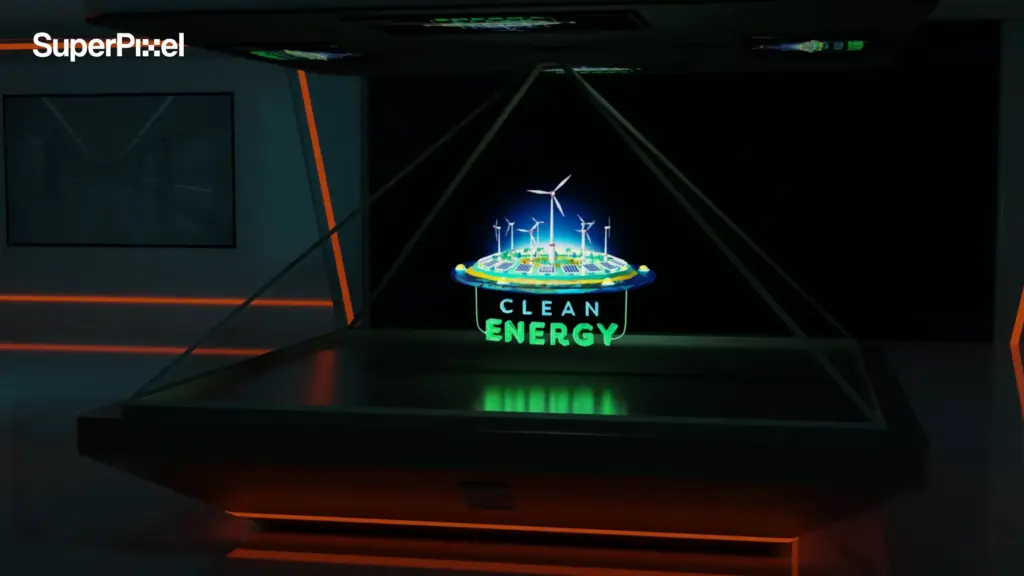
Projection distance, screen size, transparent surfaces, rigging positions, and the available depth behind or around the display all affect what can be built. These are technical details, but they quickly become creative decisions. Limited depth may reduce the achievable scale. A narrower viewing window may push the animation towards cleaner silhouettes and more controlled movement. Hardware should inform the concept without becoming the concept.
4. Content designed for the illusion
Holographic content usually benefits from restraint. Dense backgrounds, rapid edits, small type, and too many simultaneous movements can weaken the sense of separation. A slower entrance, a stronger silhouette, clearer spacing, and deliberate pauses often give the effect more room to land. This is where conventional 3D production has to be adapted for the display rather than simply exported to it.
That is also where SuperPixel’s 3D animation experience becomes relevant: modelling, lighting, motion, and compositing still matter, but they are shaped around how the final display will be viewed.
When Another Immersive Format Is the Better Decision
A credible holographic projection partner should also be able to explain when not to use it. Different spatial formats solve different communication problems, and forcing every brief into the same technology usually creates unnecessary compromises.
Projection mapping is a good example. For Prudential’s Star Club Gala at Çırağan Palace Kempinski, SuperPixel produced a four-minute projection mapping show that blended traditional mosaic motifs with modern geometric forms. The venue itself already carried visual and emotional weight, so the stronger creative decision was to activate the architecture rather than isolate a floating object in front of it.
The same logic applies to bright public environments. A large LED display may outperform a more delicate holographic image when visibility from a distance is the priority. SuperPixel’s anamorphic work is built around that kind of screen-first thinking, where perspective, scale, and public viewing position drive the animation from the start.
If the brief needs long-distance impact rather than an isolated illusion, 3D anamorphic animation may be the more appropriate starting point.
What Marketing Teams Should Clarify Before Production
Before asking for a quotation, resolve the decisions that affect both the creative and technical plan. Start with the venue: ceiling height, available depth, rigging, light control, power, traffic flow, and the likely viewing positions. Then define the audience behaviour. Are people expected to stop and watch, pass by, gather for a timed reveal, or interact with the installation?
Next, simplify the communication job. Decide what the viewer should understand in the first few seconds and what should happen next. Product reveal, brand atmosphere, technical explanation, and audience participation need different pacing. Most briefs arrive with too many points; the first useful production decision is often subtraction.
Finally, clarify what exists beyond the hero moment. Does the content need an idle loop, alternate language versions, social cutdowns, event cues, or handoff files for the AV team? These requirements are easier and cheaper to plan before the animation is locked.
What Budgets and Timelines Usually Depend On
There is no useful universal price for holographic projection because the scope sits across content, venue, and technical setup. Budget and timing change with the amount of original 3D work, complexity of the illusion, duration, number of versions, venue certainty, testing requirements, and installation coordination. A contained exhibition sequence and a stage-scale presentation may use similar language but require very different production plans.
The biggest scheduling risk is usually unresolved information. Late changes to screen specifications, viewing positions, cue timing, or approvals can force creative work to be rebuilt. On-site testing should therefore be treated as part of production, not as a final courtesy check.
Frequently Asked Questions
Is holographic projection suitable for every event space?
No. Lighting, sightlines, viewing distance, display position, and available installation depth can all affect whether the illusion reads clearly.
Does holographic projection always need a dark room?
Not always, but stronger light control generally gives the image more separation. The exact requirement depends on the display method and venue conditions.
Can existing 3D animation be reused for a holographic display?
Sometimes, but it usually needs adaptation. Pacing, contrast, composition, scale, and background treatment may need to change for the final display.
When is projection mapping a better choice?
Choose mapping when the wall, stage, façade, or architecture should become part of the story rather than simply frame an isolated visual.
What should I send to a studio before asking for a quote?
Share venue photos or drawings, viewing positions, display specifications, audience behaviour, content goals, required duration, launch date, and any existing 3D or brand assets.
Have a Venue or Display in Mind?
If you already know the space, screen, or event moment you are designing around, that is enough to start a useful conversation. SuperPixel can help shape the content around the real viewing conditions and determine whether holographic projection, projection mapping, LED, or another spatial format makes the most sense.
Explore selected SuperPixel projects or contact the team with your venue references and brief.