


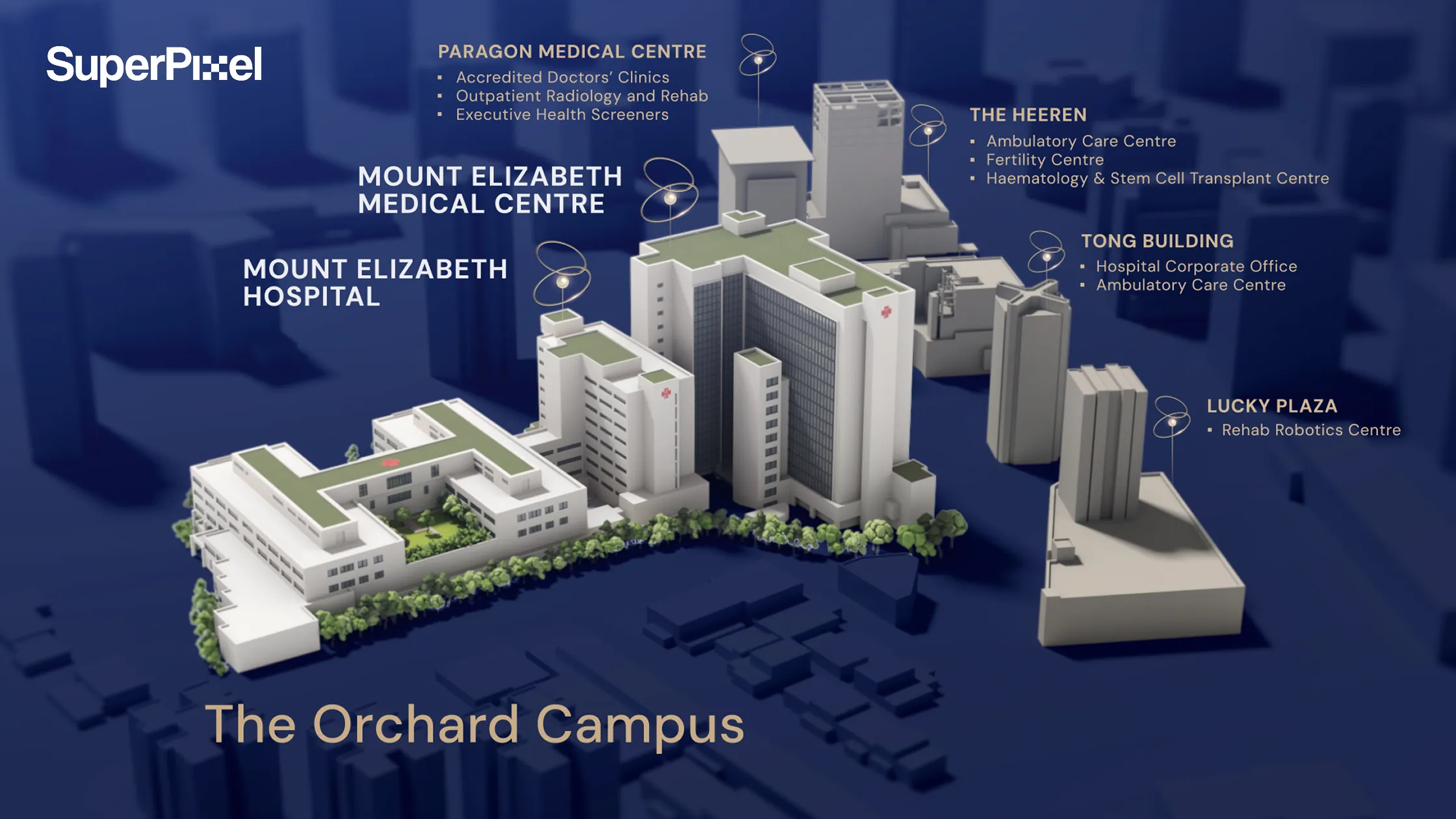
Architectural animation can mean very different things depending on the project. A property developer may need a cinematic film to sell an unbuilt tower. A public-space campaign may need an anamorphic LED illusion that reads in seconds. Another brief may call for projection mapping, real-time interaction, or a large masterplan visualisation.
That is why the “best” architectural animation studio depends on what the animation has to do. The studios below are not interchangeable. Each has a different strength, from public-screen spectacle to luxury property marketing and large-scale visualisation.
Here are 5 architectural animation studios worth knowing in 2026, followed by a practical guide to choosing the right partner.
1. SuperPixel — Best for Large-Scale LED and Anamorphic Public Displays
SuperPixel is a Singapore-based animation studio with teams in Melbourne, Vancouver, and Jakarta. Its architectural work is strongest where animation meets a physical screen: large-format LED, naked-eye 3D anamorphic content, DOOH visuals, and perspective-led motion designed around real viewing conditions.
A facade screen is never just a large video. Screen geometry, pixel maps, dead zones, viewing distance, and the hero angle all affect the composition before animation begins.
For SPH Media’s Formula 1 Singapore collaboration, SuperPixel created a 3D anamorphic LED display featuring an F1 car bursting beyond the screen. The illusion was designed from a specific public viewpoint, with scale, framing, and motion controlled around that angle.
The Witcher 3 Leshen activation at Pavilion Kuala Lumpur used the building’s L-shaped display in a similar way, turning screen geometry into part of the visual idea.
Best suited for: brands, events, developers, and media owners planning anamorphic LED, facade content, DOOH animation, or large public-screen campaigns. See more SuperPixel 3D animation work.
2. CraveFX — Best for Immersive and Projection-Led Experiences
CraveFX is a Singapore multidisciplinary studio working across animation, VFX, interactive media, projection mapping, AR, and immersive experiences.
Its strength is combining several media systems within one physical environment. Singapore Odyssea at the National Museum of Singapore is a useful example, bringing together animation, projection, motion capture, spatial tracking, interactive systems, and reactive LED elements.
Best suited for: museums, exhibitions, public attractions, projection-led installations, and briefs that combine animation with interactive technology.
3. The Boundary — Best for Luxury Real-Estate Films and Interactive Visualisation
The Boundary operates from London, New York, and Auckland and is known for high-end architectural visualisation for major property developments.
Its work spans CGI, architectural animation, marketing films, virtual tours, and digital twins. It also develops Realspace, a sales platform for interactive off-plan property exploration.
This makes The Boundary particularly relevant when architectural animation is part of a wider property-sales experience rather than a standalone film.
Best suited for: luxury residential developments, trophy towers, international property launches, and high-end off-plan sales.
4. DBOX — Best for Brand-Led Property Marketing
DBOX combines architectural visualisation with branding, campaign strategy, film, CGI, and sales experiences. Founded by architects, the studio tends to treat a development as both a place and a consumer-facing brand.
Its work for The Ellinikon in Athens includes creative marketing, CGI imagery, and animation, while Bugatti Residences shows how architectural film can sit inside a highly controlled luxury brand world.
Best suited for: developers who need architectural animation integrated with brand positioning, launch campaigns, and property marketing.
5. Brick Visual — Best for Large-Scale Architectural Visualisation and Masterplans
Brick Visual is a Budapest-based studio specialising in architectural visualisation across still imagery, animation, and large-scale development work.
Its portfolio includes projects for architecture practices such as Zaha Hadid Architects, Kengo Kuma & Associates, and BIG. Its strength is maintaining visual consistency when a project involves many assets, viewpoints, buildings, or phases.
Best suited for: architecture practices, developers, masterplans, city-scale developments, and high-volume architectural visualisation.
How to Choose the Right Architectural Animation Studio
A strong portfolio is useful, but the most dramatic reel is not always the best predictor of fit. Before shortlisting, look at how the team thinks about the final viewing condition.
1. Can they design for the actual screen or environment?
For facade and LED work, ask about pixel maps, aspect ratios, sightlines, dead zones, viewing distance, and the hero angle. True anamorphic work depends on deliberate camera logic. The team should be able to explain where the ideal view sits and what happens when viewers move away from it.
For property films, ask whether the studio can preserve architectural accuracy while controlling mood, camera movement, and narrative.
2. Can the idea read quickly?
Public screens compete with traffic, architecture, daylight, and movement. In our experience, five seconds is generous. The first read needs to be obvious before the animation asks for a second.
The first production decision is often subtraction, not addition. Stronger architectural animation gives the screen one clear job instead of forcing brochure-level information into a glance-based format.
3. Do they use depth for a reason?
Anamorphic is not always the right answer. A flatter motion piece with stronger hierarchy, typography, and scale shifts can sometimes communicate more effectively.
Depth should direct attention, not become the entire message. A good studio should be able to explain why a concept needs perspective illusion, projection, cinematic CGI, or a simpler motion approach.
4. Do they test for the real viewing condition?
A polished studio preview is not the same as a live facade, exhibition wall, or sales-suite display. Brightness, reflections, surrounding signage, playback speed, and approach angle can reshape the result.
Ask how the team handles screen tests, proofing, fallback loops, file handoff, and final playback. Good architectural animation is designed to survive the real environment, not only the render window.
Frequently Asked Questions
Do architectural animation studios also create LED and anamorphic content?
Some do. Look for studios with actual large-format work, because LED and anamorphic projects need different screen, angle, and playback considerations.
How much does architectural animation cost?
Cost depends on scope, duration, modelling, rendering, revisions, and output format. A property film and an anamorphic LED piece can have very different production requirements.
How long does an architectural animation project take?
Timelines vary by scope and approval rounds. Projects with complex modelling, multiple stakeholders, or changing designs usually need more production time.
Can production start before the architectural design is final?
Yes, if the studio knows which elements are still changing. Major design revisions later can affect modelling, lighting, animation, and rendering.
Can one architectural animation be reused across different screens?
Usually with adaptation. Different screens may require changes to aspect ratio, composition, pixel maps, safe zones, and viewing angles.
Have a Screen or Space in Mind?
Every architectural animation starts with different constraints. Share your screen specifications, site references, or early concept, and we can help determine what approach makes sense before production begins. See SuperPixel’s work or start a conversation.