


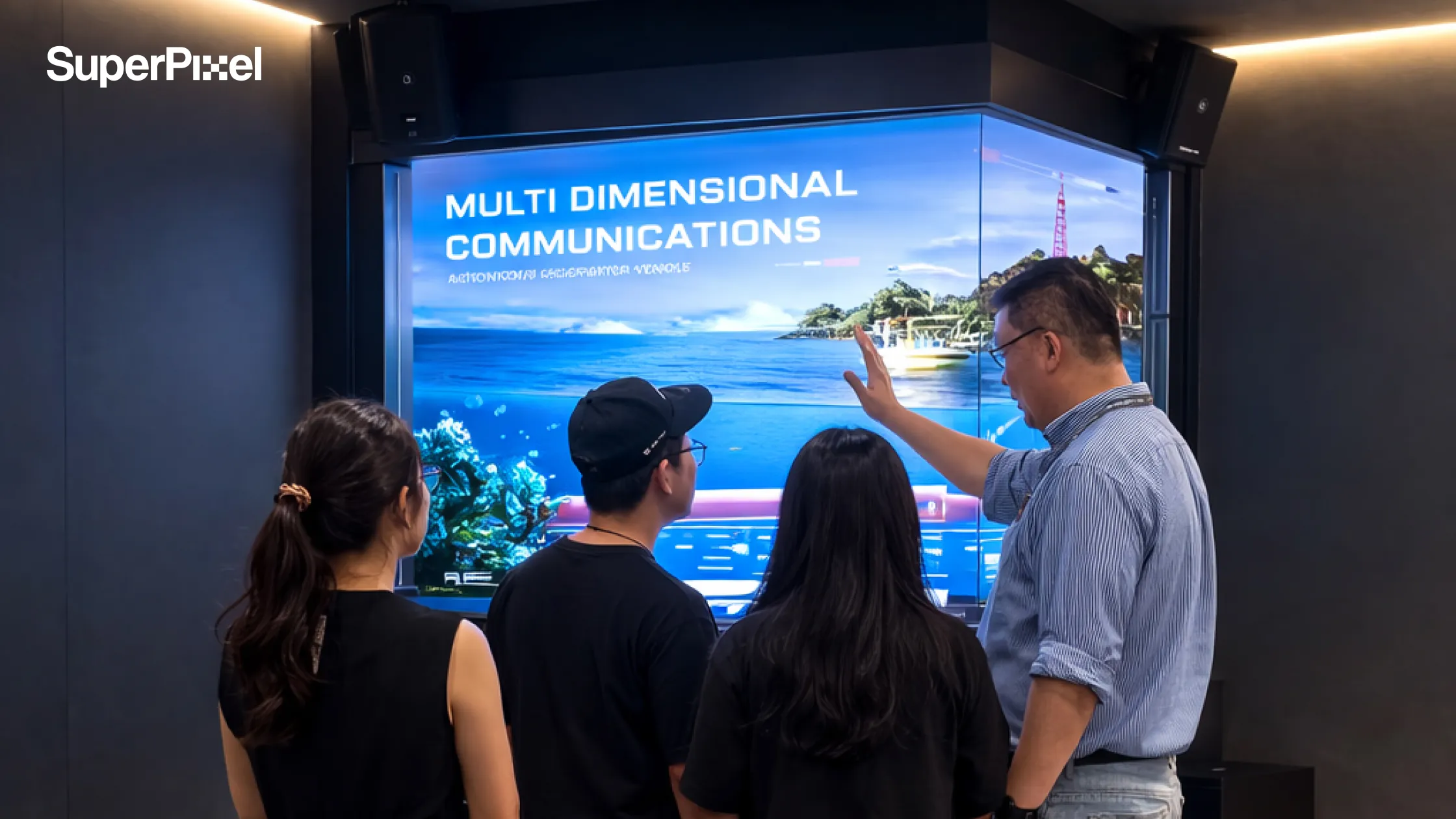
Most 3D anamorphic billboard ideas look convincing in a mock-up. The real test begins when the site enters the conversation.
A screen can be technically impressive and still be wrong for the idea. The viewing angle may be too narrow, the audience may only glance for a few seconds, or the campaign may be carrying too many messages for one illusion to handle.
Across our 3D anamorphic work at SuperPixel, we have learned that spectacle sells quickly, but the budget only makes sense when the communication job is clear. 3D anamorphic works best when one visual idea, the physical screen, and the way people encounter it are aligned from the start.
Key Takeaways
- 3D anamorphic earns its budget when one visual idea can land quickly from the intended viewing zone.
- The screen geometry and site behaviour should shape the concept before animation begins.
- Anamorphic is strongest for attention and visual impact, not dense explanation.
- The media placement and the content production are separate investments and should be evaluated separately.
When 3D Anamorphic Is Worth the Budget
The strongest use cases share one thing: the campaign can be reduced to a moment people understand before they have time to analyse it.
1. Product launches with one clear reveal
A product emerging beyond the frame, opening, transforming, or moving towards the viewer can turn a launch message into one strong visual beat. The screen starts behaving less like a panel and more like a stage. That is useful when the goal is recognition and first impression rather than detailed explanation.
For brands considering different ideas for a new product launch, anamorphic works especially well when the product itself can become the hero of that single visual moment.
2. Sports and live events where the audience is already primed for spectacle
Sports, live events, and sponsor activations already carry energy. A dramatic depth cue can feel native to the moment, and restrained beats can outperform louder sequences when the pacing matches the crowd.
3. Landmark screens where the site is part of the media value
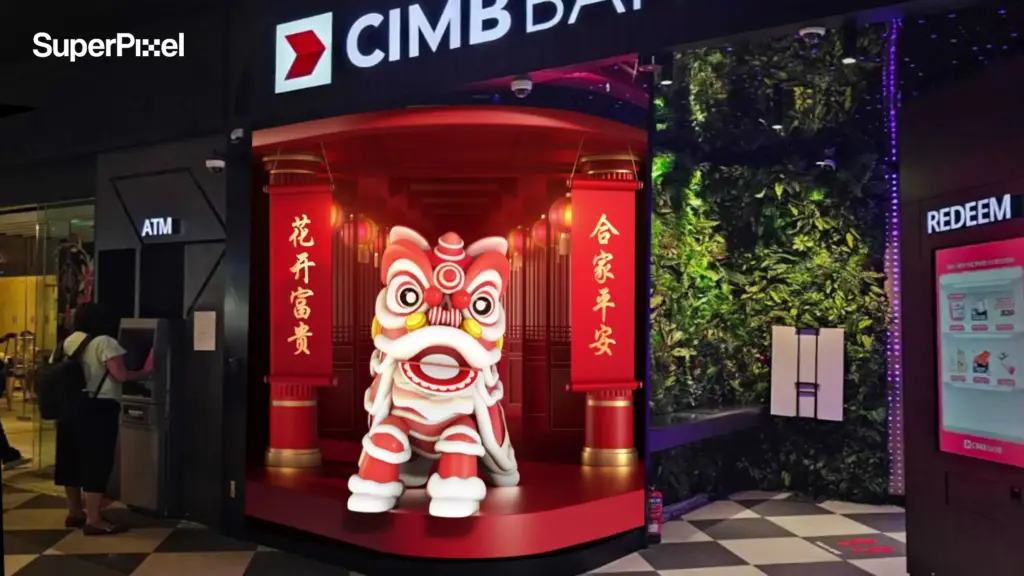
A premium facade or major public installation can add weight to a campaign, but the visual idea still has to fit the location. With an anamorphic LED display, the proportions and physical characteristics of the screen are part of the creative problem rather than simply a surface for the final asset.
Prestige amplifies a strong concept; it cannot rescue a crowded one.
The clearest test is simple: can the campaign live inside one hero image? If the answer is yes, anamorphic may deserve serious consideration. If the answer needs five selling points, three lines of copy, and a product comparison, the format is already working against the brief.
What 3D Anamorphic Does Better Than Standard LED Content
3D anamorphic is good at compressing attention into one spatial moment.
A strong sequence gives the eye one thing to lock onto. The pop-out motion leads, the framing supports it, and scale tells people where to look. A half-second of hesitation matters in public space, so the first read has to happen quickly.
We think of anamorphic as a form of visual communication built around space rather than a short film placed on a large screen. Public displays have shifting sightlines and uneven dwell time, so timing must be simpler, typography must survive distance, and shape clarity matters more than fine detail.
The technique also depends on a carefully constructed optical illusion. Perspective, framing, and movement have to work together so the image appears to extend beyond the physical screen from the intended viewing position.
It is a public-space format, not a mini brand film. The more the sequence tries to behave like conventional cinema, the easier it becomes to lose the reason for using anamorphic in the first place.
When 3D Anamorphic Is the Wrong Format
Some briefs should not use 3D anamorphic at all. Saying that early usually protects both the work and the budget.
1. When viewers need to read or compare too much
If the audience needs pricing, features, process detail, or several competing claims, choose a format that gives those ideas room. Small type collapses at distance, and layered information competes directly with the illusion.
2. When the site has weak sightlines
An anamorphic display is not 3D from everywhere. It is a planned distortion that resolves most convincingly from a chosen viewing zone. If that position is blocked, awkward, or too narrow for real foot traffic, the idea may look stronger in the presentation than it does on site.
3. When the real objective is participation
Attention and action are different goals. If people need to touch, explore, choose, or respond, an interactive experience may create more value than a non-interactive pop-out effect.
4. When the brief depends on guaranteed virality
No studio can promise that honestly. Anamorphic can create a shareable public moment, but the format still needs a communication reason beyond hoping people will film it.
What Actually Changes the Budget?
A few variables shape most of the production scope.
1. Screen geometry and media placement
A corner screen, curved facade, or unusually tall 3D LED display changes the creative problem immediately. The concept needs to be built around the real geometry, playback specifications, and intended viewing position rather than adapted at the end.
2. 3D complexity and realism
A bold stylised object is one level of production. A realistic product with reflective materials, complex lighting, and tightly controlled movement is another. If product accuracy is important, the modelling and animation work may also overlap with a broader 3D animation workflow.
3. Testing and revision scope
Proofing is not a cosmetic final step. The scene has to be checked against the actual screen logic to confirm that the depth reads from the intended position. Late changes to screen specifications or camera assumptions can create revisions that would have been avoided with earlier testing.
4. Content production and media placement are separate costs
One budget creates the asset. Another books the screen. Keeping those costs separate makes it easier to judge whether the investment is going into the content, the location, or both.
Case Study: What the SPH F1 Display Taught Us About Viewpoint Control
In 2026, SuperPixel created a 3D anamorphic LED display for SPH Media’s Formula 1 Singapore collaboration. The hero moment showed an F1 car bursting beyond the screen, but the production challenge was not simply making the car move towards the viewer.
The shot had to resolve from a specific public viewpoint. The car’s scale, wheel arcs, frame edges, and forward movement were designed around that position so the illusion read as one coherent moment rather than a distorted render.
The subject also helped. Speed already belonged to the emotional language of Formula 1, so the screen amplified a feeling the audience was ready to receive rather than manufacturing excitement from nothing.
The practical lesson is that anamorphic earns its keep when message, environment, and screen behaviour are aligned early. If one of those pieces is missing, novelty starts carrying too much of the campaign. When all three work together, the illusion has a reason to exist beyond surprise.
What to Ask Before You Commission 3D Anamorphic Content
Solve technical uncertainty before the concept frame becomes expensive to change. Before production starts, make sure the team can answer:
- What are the exact screen dimensions, resolution, pixel map, and playback rules?
- Where is the hero viewing position, and how much movement around it is acceptable?
- What is the one visual idea the audience should remember?
- Who will approve the work against the real screen or an accurate site simulation?
- How will success be judged: on-site attention, recall, social capture, campaign lift, or another measure?
If the first two answers are still unknown, the project is not ready for detailed concept development. The creative team would be designing around assumptions that may later change the entire composition.
Frequently Asked Questions
How long does 3D anamorphic production usually take?
It depends on screen geometry, realism, and revision scope. Complex work needs enough time for modelling, animation, rendering, and viewpoint proofing before final delivery.
Can a 3D anamorphic asset be reused for social media?
Yes, but usually with adaptation. The original illusion is designed for a physical screen, so a social version often needs new framing or editing to work on a flat display.
Do I need final screen specifications before production begins?
Ideally, yes. Dimensions, resolution, pixel maps, and the hero view affect the concept itself, not just the final export.
Can anamorphic content work from multiple viewing angles?
It can remain watchable from several positions, but the strongest illusion normally resolves around a planned hero view. A wider acceptable viewing zone should be discussed early.
Does SuperPixel handle the media booking as well?
Content production and media placement are separate scopes. We can design the asset around the confirmed screen requirements, while media ownership or booking depends on the project setup.
Already Have a Screen in Mind?
Send us the screen specifications, location, campaign objective, and the one visual moment you want people to remember. We can help determine whether 3D anamorphic animation is the right format before the concept is built around the wrong assumptions.
Explore selected SuperPixel projects or contact the team to discuss the brief.