


If you are comparing anamorphic animation services in Singapore, the hard part is not finding dramatic references.
The harder part is finding a partner that can turn a public screen into a clear brand message, not just a clever illusion.
In an increasingly competitive market, brands need more than spectacle. They need a screen moment that can capture attention, support the brand identity, and leave a lasting impression.
That is where 3D anamorphic content can help. When the concept is clear, the illusion can stop people, create moments worth filming, and bring brands closer to audiences in real public spaces.
Key Takeaways
- Anamorphic animation is a full production process, not one export.
- The strongest loops are built around one clear brand narrative.
- Screen geometry, vendor rules, and viewing angle should shape the storyboard early.
- Versioning for Singapore and regional markets is easier when planned before animation starts.
- The 3D effect can drive engagement, but it cannot rescue a weak idea.
What 3D anamorphic animation services in Singapore actually include
Anamorphic animation is not just regular 3D animation placed on a large LED screen.
It is a forced-perspective illusion built for a real screen, a real viewing angle, and a real audience environment.
3D anamorphic animations can create immersive experiences that draw attention and create lasting impressions, making them a powerful tool for enhancing brand narratives and driving engagement in competitive markets.
A good project usually moves through concept development, mood boards, storyboard, 3D modelling, texturing, motion design, animation, test frames, rendering, and final delivery files.
| Production stage | Why it matters |
|---|---|
| Concept | Defines the main idea before the animation becomes too complex. |
| Storyboard | Shows how the illusion, message, and loop will work together. |
| 3D modelling and texturing | Builds the object, product, character, or environment that creates depth. |
| Motion design | Controls timing, movement, and how people visually read the screen. |
| Test frames | Checks whether the illusion works from the intended viewing angle. |
| Final rendering | Prepares the animated content for the actual LED screen and vendor specs. |
Anamorphic animation services provide high-impact 3D visual experiences that appear to “pop out” of screens when viewed from specific angles.
Motion design and motion graphics for public screens
Motion design matters because public screens do not get much time.
People may be walking past a busy street, waiting at a bus shelter, entering a mall, or moving through an event venue.
That means every scene needs a job. The object, text, sound design, and movement should all help the audience understand the message quickly.
Motion graphics can support this by using expressive texts, simple transitions, clear product movement, and visual cues that guide attention.
These services are primarily used for digital out-of-home (DOOH) advertising on large LED billboards.
The immersive “naked-eye 3D” effect captures attention in high-footfall areas more effectively than static or 2D ads.
For The Witcher 3: Leshen anamorphic project, SuperPixel used the L-shaped screen at Pavilion Kuala Lumpur to create a forced-perspective illusion where the Leshen appeared to stand inside a dark forest space and move beyond the physical frame of the screen.
The motion design focused on depth, atmosphere, and audience surprise. By using the screen corner, visual framing, fog, moving branches, flying crows, and layered 3D motion, the project turned a flat LED display into an immersive public moment that made people stop, look, and experience the world of The Witcher in a more physical way.
Read more about When Animation Scripting Is the Right Fit for a Complex Explainer
Where immersive experience works best in Singapore
Anamorphic content works best when the screen location, target market, and campaign goal are clear.
It can be used for outdoor advertising, retail launches, corporate videos, event screens, exhibitions, and high end brand activations.
| Placement | Best for | What to consider |
|---|---|---|
| Outdoor LED screens | Brand awareness and public advertising. | The idea must be readable at a glance. |
| Retail and mall screens | Product launches and shopper engagement. | The loop should be simple enough to understand halfway through. |
| Bus shelter screens | Short local messages and street-level visibility. | Copy and motion should be clear for people passing by. |
| MICE and exhibitions | Corporate branding, launches, and event experiences. | The screen can support a bigger brand environment. |
| Attractions and destinations | Shareable moments and immersive brand presence. | The visual should be easy to film, remember, and share. |
3D visuals for large LED billboards are commonly used for outdoor advertising at landmarks like Raffles Place and Changi Airport.
3D anamorphic animations can enhance brand visibility by creating immersive experiences that draw attention and create lasting impressions in busy public spaces.
Unique visual spectacles in 3D anamorphic displays have viral potential, as viewers are likely to film and share content.
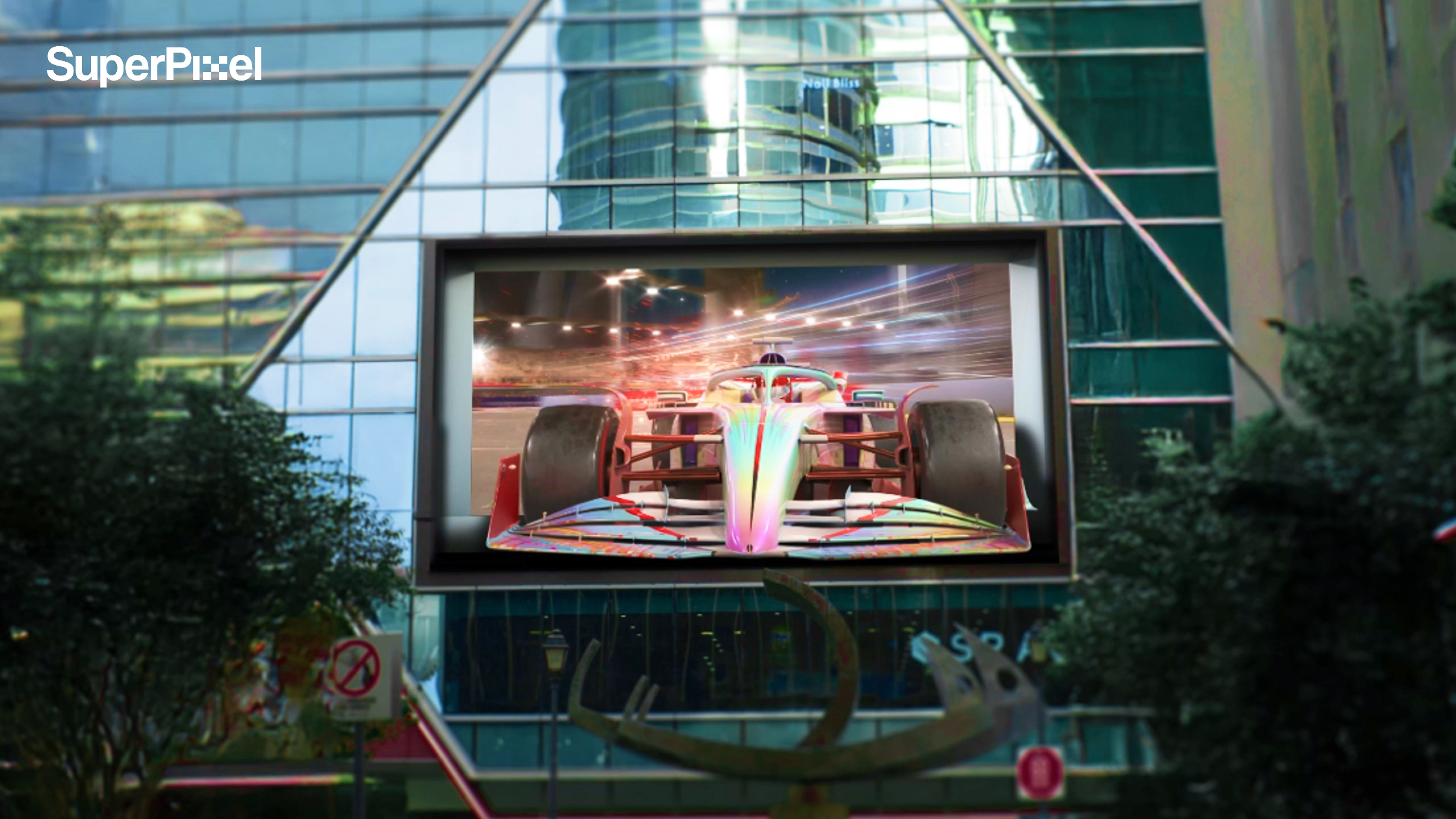
Case Study: SPH F1 3D Anamorphic
For the SPH F1 3D anamorphic project, SuperPixel created a high-impact public screen experience designed to stop people in a busy urban setting.
The visual focused on a Formula 1 car that appeared to burst out of the screen, using a shadow-box setup to create the illusion of real depth inside the display.
To make the naked-eye 3D effect feel stronger, the animation used sparks, smoke, and bold 3D typography placed at the front of the composition.
This project shows how anamorphic animation can turn DOOH advertising into an immersive brand moment that captures attention quickly and leaves a lasting impression.
Read more about Healthcare Explainer Video: How to Make Medical Information Easier to Understand
How 3D anamorphic content supports marketing and advertising
Anamorphic animation is not only about technology.
It is also a marketing tool.
The right screen moment can support brand identity, create social proof, drive engagement, and make people interact with the brand beyond the physical location.
Integrating 3D anamorphic content into marketing strategies can lead to increased social media shares and interactions, as people are likely to take pictures and share their experiences online, extending the reach of the campaign beyond physical locations.
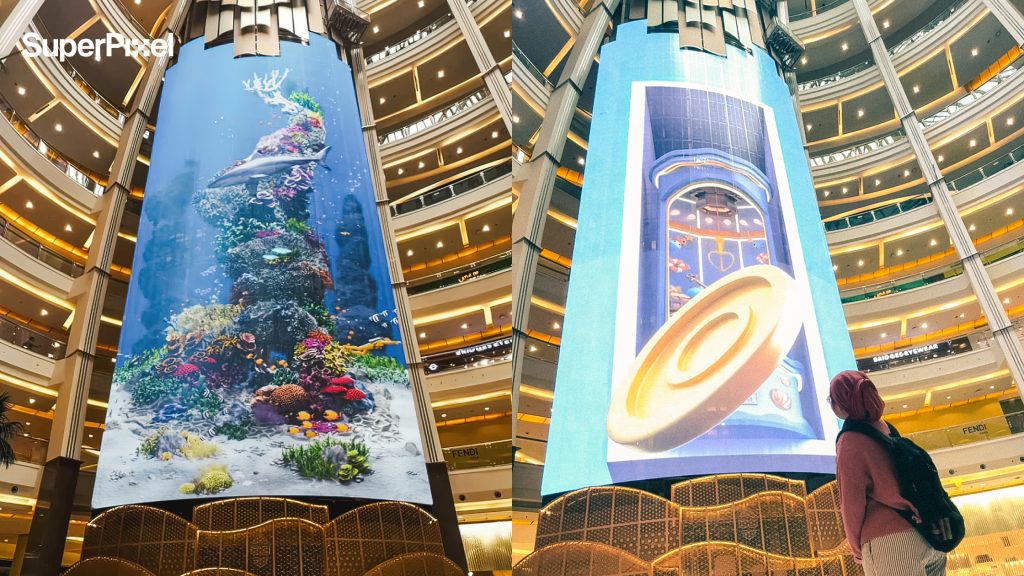
To maximize the effectiveness of 3D anamorphic animations, marketers should consider social media integration and create shareable content that encourages audience interaction, effectively turning viewers into brand advocates.
Effective 3D anamorphic content encourages audience interaction, leading to social media shares that extend the brand’s reach beyond physical locations.
This is why the concept should be easy to capture on camera.
A good anamorphic idea should work for the people standing in front of the screen and for the people who later see it online.
Brand mascot, brand identity, and brand narrative
Anamorphic animation can work especially well when the brand has a strong visual asset.
That could be a product, a brand mascot, a hero object, or a visual world connected to the campaign.
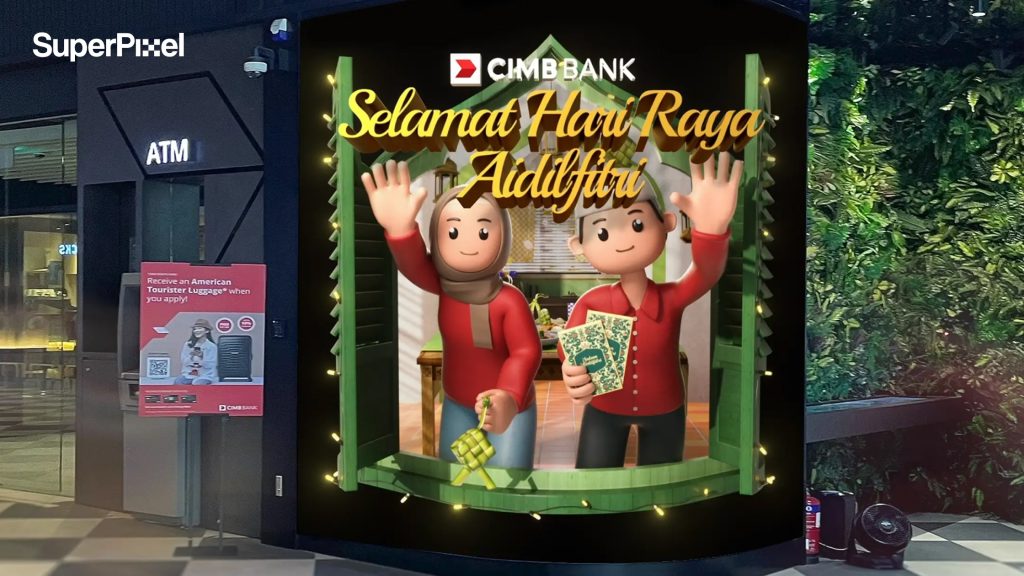
A brand mascot can give the illusion more life. It can move, react, appear from the screen, or interact with the environment in a way that feels more human.
For a high end brand, the same format can be used differently. The movement may be slower, cleaner, and more focused on elegance, craft, and excellence.
The key is not to add more effects. The key is to make the brand narrative easier to understand.
3D anamorphic animation is an emerging trend that creates immersive experiences, allowing brands to connect with audiences in public spaces and generate shareable moments.
How 3D animation and cutting edge technology create the illusion
The 3D effect works because the animation is built around perspective.
The content is designed so flat surfaces appear to have depth when viewed from the right angle.
These animations leverage optical illusions to transform flat surfaces into dynamic scenes, generating high levels of awareness and engagement for brands.
Forced perspective employs specialized 3D modeling and texturing to create depth illusions on flat or L-shaped screens.
The forced perspective technique is calibrated to specific viewing angles and curved or corner-wrapping LED displays.
3D anamorphic content uses clever tricks to make flat pictures look 3D, utilizing techniques like 3D projection mapping to ensure the image appears lifelike from specific angles.
High-resolution output leverages state-of-the-art LED technology for maximum clarity in visual displays.
This is where cutting edge technology, creativity, and production discipline have to work together.
If the viewing angle is wrong, the illusion may break. If the screen specs arrive late, even strong animated content can lose impact.
Key technology behind 3D anamorphic animation
The software matters, but it is not the whole answer.
A strong team still needs concept thinking, motion timing, lighting, texturing, screen testing, and delivery discipline.
Key technologies involved in 3D anamorphic content include 3D animation software like Blender, Maya, and Cinema 4D, as well as high-resolution LED screens for effective visual impact.
Key technologies behind 3D anamorphic billboards include 3D animation software such as Blender, Maya, and Cinema 4D, which are used for creating detailed and realistic animations.
Popular tools for creating 3D anamorphic content include Blender, an open-source software for 3D modeling and animation, Maya, which is known for complex animations, and Cinema 4D, recognized for its user-friendly interface and powerful rendering capabilities.
3D animation services include a full production workflow—3D modeling, texturing, animation, and final rendering.
Tools help create the work. But the real value is in how the team uses those tools to make the message clear.
What to prepare before briefing an experienced team
A strong brief helps the studio build the right illusion from the start.
The process of creating 3D anamorphic content begins with understanding the brand’s message and target audience, followed by brainstorming, mood boards, and storyboarding to visualize the concept.
| What to prepare | Why it matters |
|---|---|
| Screen specifications | Helps plan the correct size, safe area, and viewing angle. |
| Physical layout | Corner screens, curved screens, and flat screens need different planning. |
| Target market | Shapes the tone, concept, pacing, and call to action. |
| Brand assets | Logos, product renders, brand mascot, colours, and approved copy help avoid delays. |
| Campaign goal | A launch screen, retail screen, and corporate branding screen do different jobs. |
| Vendor rules | File format, playback limits, and technical specs can affect final delivery. |
| Social media plan | Helps the team create shareable content that can live beyond the screen. |
An experienced team should work closely with clients before full production starts.
That is how customized solutions become possible. The studio can shape the concept around the screen, audience, and business goal instead of forcing a generic 3D idea onto every project.
What brands often get wrong about 3D anamorphic screens
The most common mistake is treating novelty as the message.
A screen can look impressive and still fail to communicate anything useful.
| Common mistake | Why it becomes a problem |
|---|---|
| Trying to say too much | A crowded screen makes the illusion harder to understand. |
| Starting with the 3D effect | The animation may look impressive but feel disconnected from the brand. |
| Ignoring screen specs | Late technical details can weaken the illusion and delay production. |
| Adding too much text | Public audiences rarely have time to read long copy. |
| Skipping test frames | Viewing issues may only appear after too much work has been done. |
The best anamorphic work is usually simple.
One hero object. One clear movement. One message people can understand quickly.
How to choose an experienced team for motion graphics and 3D anamorphic work
Choosing the right studio is not only about the showreel.
A good showreel shows visual quality. But it does not always show how the team thinks, tests, revises, and works with real screen constraints.
Singapore has a growing ecosystem of specialized animation studios capable of delivering naked-eye 3D and anamorphic illusions.
Reputable companies in Singapore specializing in 3D anamorphic animations create high-impact, illusion-based visual content for large-scale outdoor LED screens, retail, and corporate branding.
Before choosing a partner, ask practical questions.
| Question to ask | What it reveals |
|---|---|
| What do you need before storyboarding? | Shows whether the team understands screen logic early. |
| How do you test the viewing angle? | Shows whether the illusion is calibrated properly. |
| What gets approved before animation starts? | Helps avoid late changes during production. |
| How do you plan social sharing? | Shows whether the content can extend beyond physical locations. |
| Can one master support multiple markets? | Shows whether the team understands adaptation and versioning. |
| How do you prepare files for venue specs? | Shows whether delivery is planned properly. |
The right partner should help connect brand, screen, audience, and production reality.
That is how anamorphic animation can become more than a visual trick. It becomes a powerful tool for brand storytelling, advertising, and public engagement.
What good proof looks like beyond a showreel
A strong anamorphic studio should be able to show more than a polished final video.
Look for storyboard thinking, test-frame logic, screen mockups, production planning, and examples of how the final animation was adapted to the screen.
Good proof may include:
- storyboard frames
- screen mockups
- viewing angle tests
- loop timing samples
- expressive texts tests
- before-and-after adaptations
- final screen delivery examples
- regional or language versioning examples
This helps you see whether the studio can handle both creativity and technical delivery.
If you are exploring whether anamorphic animation services in Singapore are right for your project, SuperPixel can help assess the screen logic, message clarity, and production fit before frames are made.
Frequently Asked Questions
How much do anamorphic animation services in Singapore usually cost?
Cost depends on screen geometry, runtime, number of versions, 3D complexity, and delivery requirements.
Can anamorphic content work on any LED screen?
No, the effect depends on screen shape, viewing angle, screen size, and how much control you have over where the audience stands.
Should I create separate anamorphic versions for Singapore and other Southeast Asian markets?
Sometimes, separate versions are better if the language, CTA, or screen format changes the pacing of the animation.
How long does an anamorphic animation project usually take?
A practical timeline is often around six to ten weeks from brief lock to final delivery.
What should I prepare before briefing an anamorphic studio?
Prepare the screen specs, viewing angle, campaign goal, brand assets, approved copy, vendor rules, and any language version requirements.
What makes anamorphic animation effective?
It works best when the 3D illusion supports one clear message that people can understand quickly in a public space.