


Augmented reality marketing examples are useful not because they show the newest technology, but because they show how brands invite people to do something.
A good AR campaign gives users a clear action, shows an immediate response, and makes the brand message easier to understand through interaction. That action can be as simple as scanning a QR code, placing a character in a real location, trying on a product, or tapping a screen to move through a game.
For brands, the question is not only, “Can we use AR?”
The better question is, “What should people do, what should happen next, and what should they understand after the interaction?”
Below are augmented reality marketing examples from SuperPixel and global brands, with practical lessons for teams planning their own AR campaign.
Key Takeaways
- Strong AR marketing starts with a clear user action, not the technology itself.
- The best examples give people immediate feedback, such as movement, sound, reveal, or transformation.
- AR can support product try-ons, packaging, events, cultural campaigns, retail activations, and brand storytelling.
- Simple mechanics often work better than complex interactions, especially in public or mobile-first settings.
- Before starting an AR campaign, brands should define the action, the feedback, the setting, and the message.
1. SuperPixel, Panjat Pinang AR Gamification
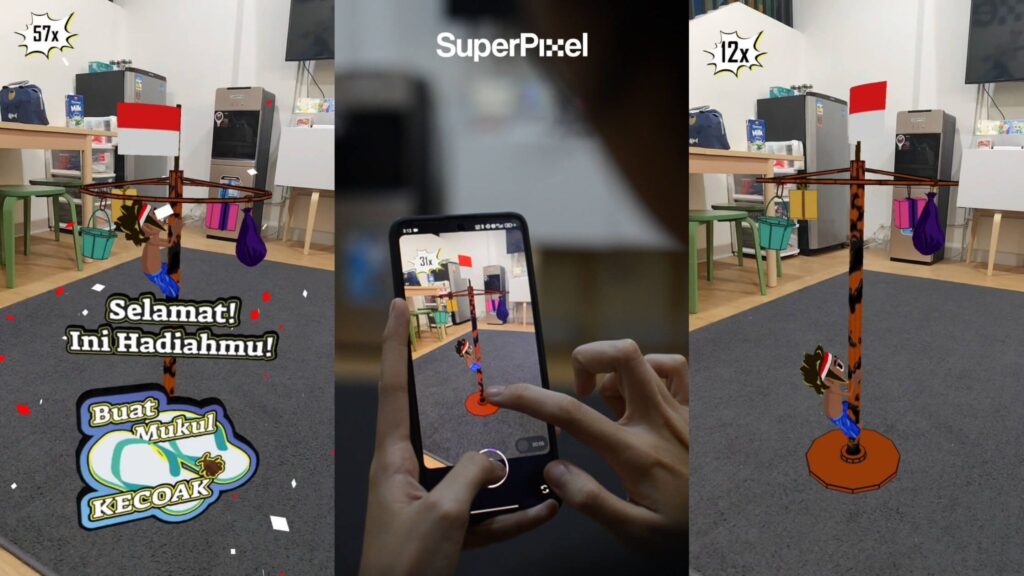
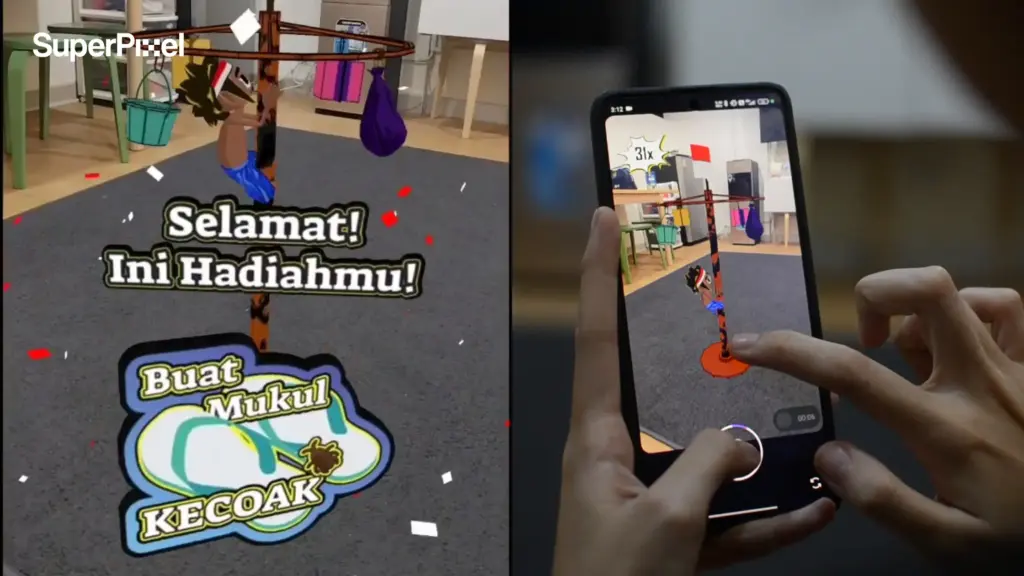
Panjat Pinang AR took a familiar cultural game in Indonesia and turned it into a simple tap-and-climb experience.
There was no complicated onboarding. Users tapped, the character moved, and the screen responded with motion, sound, and visual effects. The action was clear from the first few seconds, which made the experience easy to pick up without a long instruction screen.
That familiarity mattered. Instead of asking people to understand a completely new concept, the AR experience started from something they already recognised, then translated it into a quick digital interaction.
For brands, this is a useful reminder that AR does not need to be complex to work well. A clear action, a visible response, and a familiar idea can give people enough reason to keep playing.
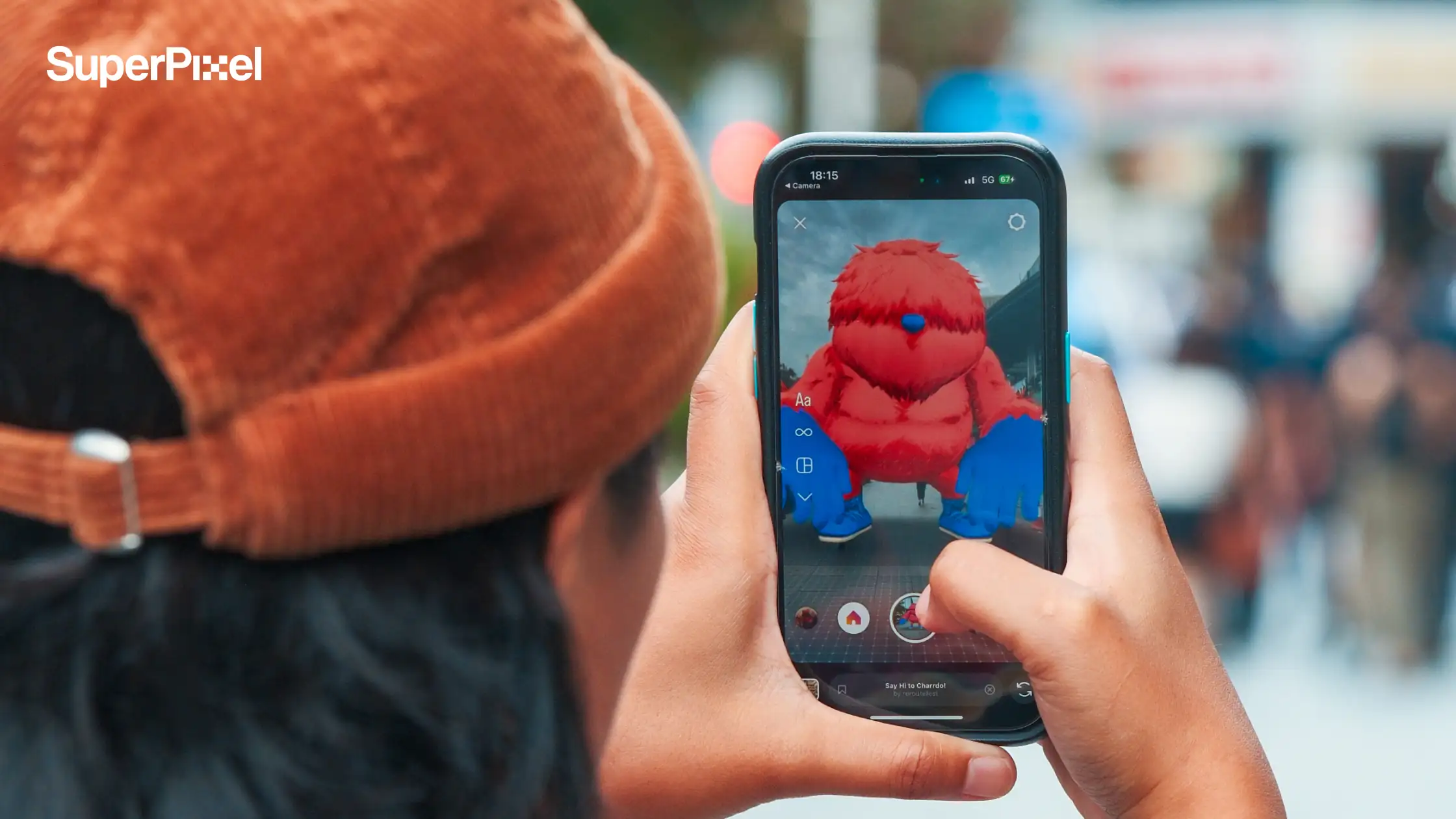
2. SuperPixel, Re-Route Festival AR Monster
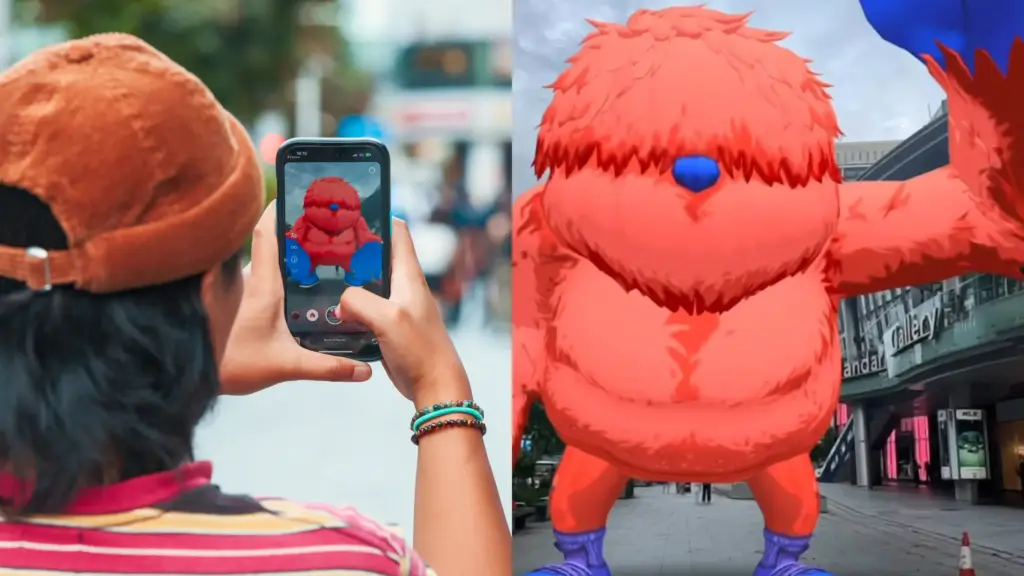
For Singapore Design Week, SuperPixel created a location-based AR experience along Orchard Road, featuring animated 3D monster characters by artist ANTZ.
Attendees scanned QR codes along the route and placed the characters into real-world locations around them. The artwork was no longer only something to look at. It became something people could find, place, and experience as part of the city.
That made the route feel more active. People had a reason to stop, scan, look around, and see the space differently.
This is where location-based AR is strongest. The place should not just be a background. It should add something to the experience. When the setting matters, the interaction feels more connected to the campaign.
AR Examples From Other Brands
These examples are included for what they teach about the mechanic, not as an endorsement of the brand or campaign.
1. IKEA Place, AR Home Design
IKEA Place lets users place 3D furniture models inside their own homes through AR, so they can see how a chair, table, or sofa might fit before buying.
What brands can learn: AR works well when the product needs to be imagined in a real space rather than described in a listing.
2. Sephora Virtual Artist, AR Beauty Try-On
Sephora’s Virtual Artist allows users to try makeup shades virtually before making a purchase.
What brands can learn: Instead of asking customers to guess how a colour might look on them, AR can bring the trial moment closer to the buying decision.
3. Nike Fit, AR Shoe Sizing
Nike Fit uses AR to scan a customer’s feet and recommend a shoe size.
What brands can learn: AR does not always need to be playful or decorative. It can also help people measure, compare, and choose with more confidence.
4. Pepsi Max, AR Bus Stop Campaign
Pepsi Max used AR screens at a bus stop to layer digital scenes onto the real street view behind it.
What brands can learn: This only works if the AR content responds to what’s actually in view, not just sits on top of it. The same thinking has been applied by other brands using AR on outdoor walls and vending formats, the location becomes part of the reveal rather than a backdrop for it.
5. Burger King, Burn That Ad
Burger King’s “Burn That Ad” campaign let users scan competitor ads and watch them appear to burn away, revealing a reward.
What brands can learn: The mechanic and the brand’s tone were the same thing here, a competitive jab expressed as an interaction rather than a slogan. The action itself can carry personality, not just the reward at the end.
6. Coca-Cola, AR Holiday Packaging
Coca-Cola used AR packaging to unlock animated holiday scenes and messages from its cans.
What brands can learn: AR does not always need a big installation. Sometimes the entry point can be a product people already hold, which is the same logic other brands have used to turn print materials such as offers or brochures into scan-and-reveal moments.
7. Kinder, AR Portal Experience
Kinder created an AR portal in a supermarket setting, inviting children to look through a digital doorway into a safari world.
What brands can learn: The interaction had one clear visual invitation, open the portal and look inside. A single obvious action is often stronger than several smaller ones.
Lessons Across These Examples
Looking at SuperPixel’s own work alongside the examples above, a pattern holds regardless of budget or brand size.
The strongest AR experiences share three things: the user knows what to do almost immediately, something responds the moment they do it, and that response helps them understand a product, place, character, or offer more clearly than a static image or a paragraph of copy could.
None of this depends on the AR being technically advanced. Panjat Pinang’s tap-and-climb mechanic and Kinder’s portal are both simple ideas. What makes them work is that the feedback is immediate and the action is obvious, not that the technology is impressive.
When Is AR Marketing a Good Fit?
AR marketing can be useful when your campaign needs people to interact with a product, place, object, or story.
It may be a good fit for:
- product try-ons and product previews
- retail and mall activations
- event experiences
- tourism and destination campaigns
- character-led campaigns
- cultural or seasonal campaigns
- packaging and print extensions
- public-facing education
- F&B, beauty, fashion, lifestyle, and entertainment campaigns
AR may also work when your brand already has a strong visual world that can be extended into the user’s environment.
What Brands Should Prepare Before Creating an AR Campaign
Before starting an AR marketing project, prepare a few clear inputs.
1. The user action
Decide what people should do. Should they scan, tap, move, place, collect, open, try, or explore? The clearer the action, the easier the experience is to design.
2. The feedback moment
Decide what happens after the action. Does something move? Does a character appear? Does a product change? Does a sound confirm the action? Does a reward appear? Good AR needs feedback that users can understand instantly.
3. The campaign message
Write the message in one sentence. For example: “Let people preview how the product fits their space,” or “Turn a familiar cultural game into a mobile interaction.” This gives the creative team a stronger starting point than simply asking for “something AR”.
4. The setting
Think about where the AR will be used. At home, in a store, at an event, on a street, inside a mall, during a festival. The setting affects the mechanic, animation length, visual size, sound design, and how much instruction the user needs.
5. The assets
Prepare any product files, campaign visuals, characters, packaging, brand guidelines, location photos, or existing 3D assets. These help the creative team decide what can be adapted and what needs to be created from scratch.
How SuperPixel Can Help With AR Marketing
SuperPixel approaches AR as a creative interaction, not just a technology layer. The same questions that shaped Panjat Pinang’s tap-and-climb mechanic and Re-Route Festival’s location-based reveal apply to any new brief: what should someone do, what happens the moment they do it, and what should they understand afterwards.
For brands, agencies, event teams, and campaign planners, we can help shape that thinking before production starts, covering the core mechanic, visual direction, user flow, animated assets, feedback moments, and how the AR experience connects back to the campaign message.
Planning an AR Campaign?
A product launch, cultural campaign, retail activation, event experience, or public-facing message may not need a bigger idea. It may need a clearer interaction.
SuperPixel can help shape augmented reality marketing concepts around the action, feedback, visual story, and setting. Whether the experience starts from a QR code, a product, a place, or a character, the best work usually begins with one simple user action.
Tell us what people need to understand, and we can help explore the clearest way to make it interactive.