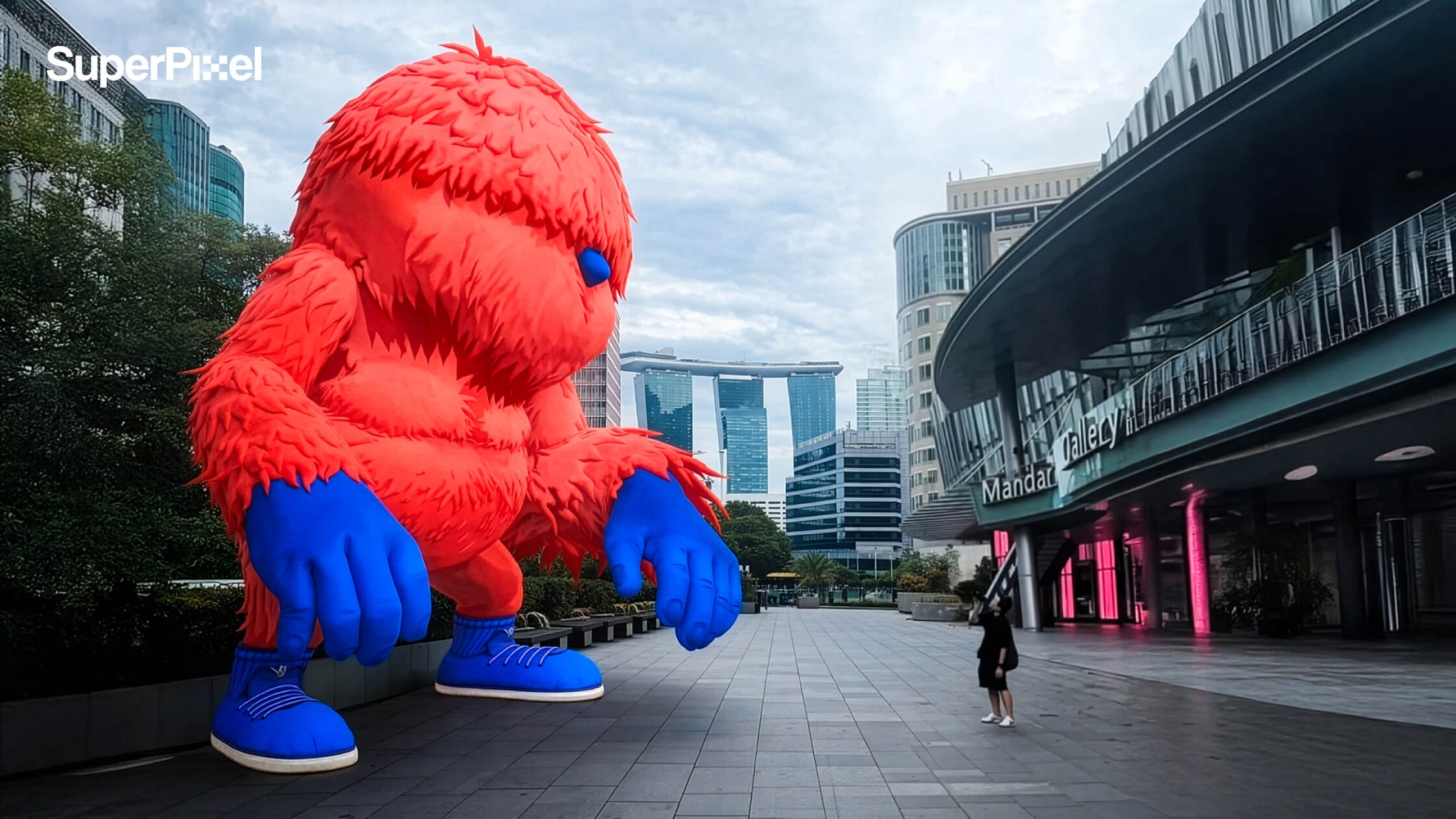
Think about your favourite animated movie. Now imagine being able to place that character on your table, walk around it, and trigger a reaction with a tap.
That’s the shift we’re seeing. AR today isn’t just a visual layer on top of a camera feed. It’s spatial computing, content that understands space and lives inside it.
Why does this matter? Because presence changes memory. When an object feels like it exists in your physical environment, your brain treats it differently. You don’t just see it. You experience it.
At SuperPixel, we blend fine-art aesthetics with technical precision. Clean visuals are great. Spatial awareness is what makes them stick.
Key takeaways:
- AR works because it creates a sense of presence
- Spatial computing goes beyond camera overlays
- Real-world lighting and surfaces matter
- Performance is as important as visual style
- Interaction turns viewers into participants
Core Tech: How AR “Sees” the World
Before animation moves, AR needs to understand where it lives.
Image Tracking: The Digital Anchor
Think of this as the “Scan and Spark” method. This technique needs a visual cue to tell your smartphone camera exactly where the magic should happen.
- How it works: Our system is trained to recognize specific images like a greeting card, a poster, or a product brochure. Once the camera spots that image, it uses it as a “digital anchor.”
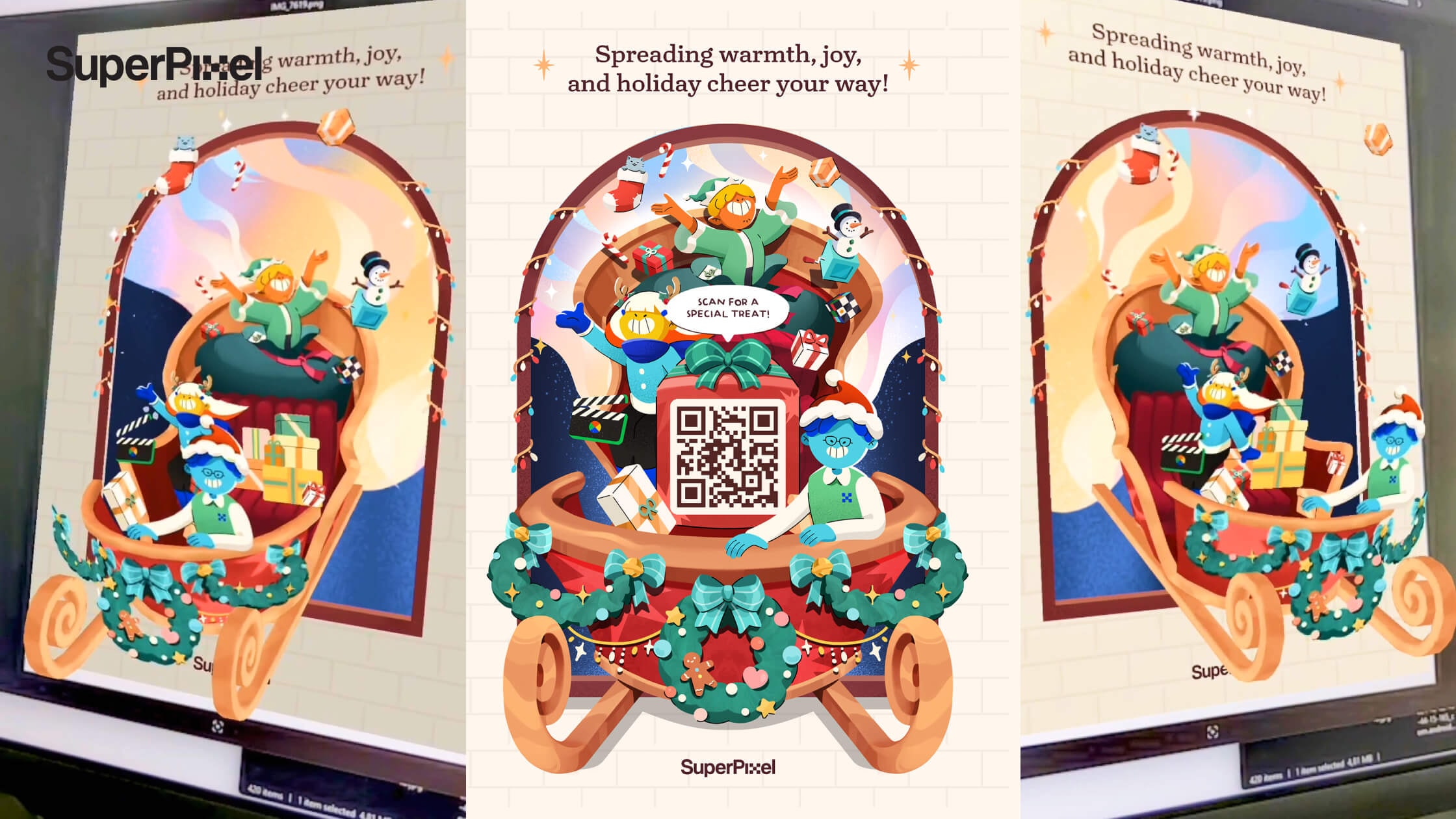
- The Experience: This is what we used for our Christmas AR project. When you scan the festive card, a 3D character pops up right on top of it. If you move the card, the animation moves with it. It’s precise, consistent, and feels like the paper itself is coming to life!
2. World Tracking: The Magic of Spatial Awareness
This is where technology feels like actual sorcery. In this mode, your smartphone doesn’t need a picture to follow; it simply “feels” the world around it.
- How it works: Using advanced sensors, your phone detects flat surfaces like floors, tables, or pavements. It then “plants” the 3D object onto that surface as if it were a real, physical item.
- The Experience: This is the tech behind our Panjat Pinang AR filter. You don’t need to scan a poster; just point your camera at the floor, and the climbing pole appears right in your living room. You can even walk around the object, and it stays perfectly in place. It feels solid, real, and totally grounded in the physical world.
Light Estimation
Nothing breaks immersion faster than a floating object with the wrong lighting. Modern AR frameworks read ambient light and colour temperature so shadows and highlights adapt to the room. That’s how a digital character stops looking pasted on.
Visual Engineering: High Fidelity, Low Overhead
Great AR visuals aren’t about pushing devices to their limits. They’re about smart decisions.
The Hybrid Asset Pipeline (AI + Human Craft)
In one of our public AR projects, we experimented with AI-generated base textures inspired by painterly styles. Our artists then refined them manually that sharpening edges, adjusting contrast, fixing expressions.
AI helped us explore faster. Human hands made it believable.
Polygon Budgeting & Texture Baking
Phones heat up fast. We plan polygon counts carefully and bake lighting details into textures so real-time engines don’t work overtime. The goal is smooth interaction on mid-range devices, not benchmark scores.
The Interaction Framework: Designing for the Thumb and the Body
Good AR doesn’t need instructions. It invites play.
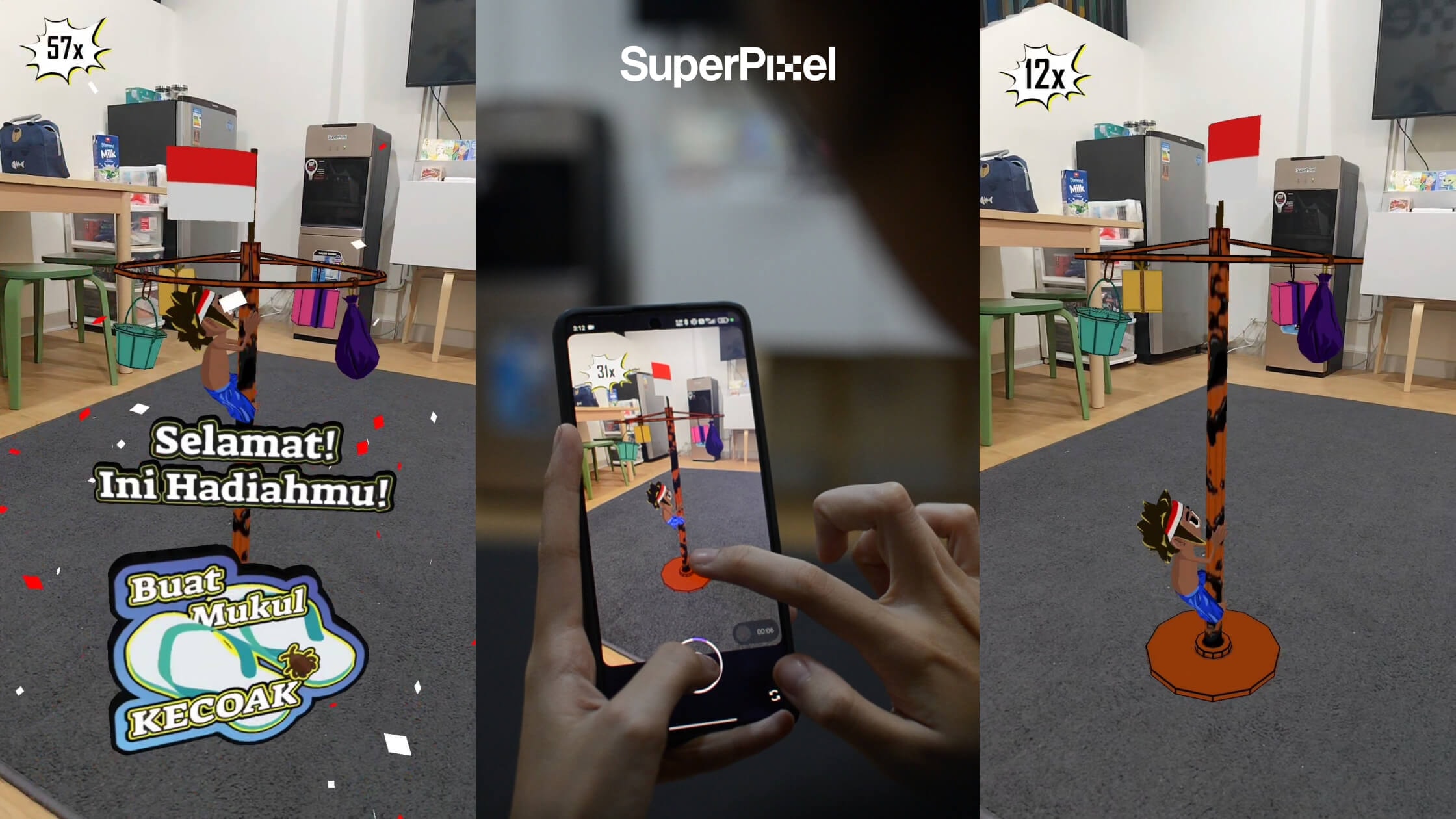
Case Study 1: Panjat Pinang AR
Inspired by a familiar cultural game, this AR experience turned tradition into a tap-and-climb mechanic. Simple rules. Clear feedback. Addictive progression.
Every tap had a response such as movement, sound, particles. According to WOW-How (2022), this kind of lightweight gamification boosts engagement because users immediately understand cause and effect.
Visual & Haptic Feedback
Tiny details matter. A vibration when you succeed. A visual burst when you reach a goal. These cues reassure users that the system is listening.
Development Stack: Unity & Beyond
Unity remains our go-to engine for AR projects. It handles sensors, physics, and interaction logic with flexibility.
Web-based AR vs. App-based AR
Web AR wins on accessibility: no downloads, instant access. App-based AR offers deeper interaction and better performance. The choice depends on context, audience, and duration of engagement.
Testing Is Non-Negotiable
Different phones. Different lighting. Different environments. We test in all of them. What works in a studio might fail outdoors at noon.
AR as a Storytelling Powerhouse
How We Build High-End AR Experiences
Beyond the Phone The world of augmented reality experiences has evolved way past those basic face filters on your smartphone. We’re standing on the edge of a revolution where digital content blends seamlessly with the physical world.
From an ar app running on a mobile phone or tablet to cutting edge technology like Microsoft Hololens, our ability to interact with digital images in real life is becoming limitless.
This evolution allows brands to stop just showing visuals and start creating immersive learning experiences where the audience moves freely, unhindered by the screen.
We are constantly hunting for exciting ways of using augmented reality for specific needs. Take our Christmas AR project as an example: using advanced Image Tracking, a simple qr code scan makes a greeting card come alive with 3D animation.
It’s not just entertainment; it’s an innovative way for companies to tell their stories and level up the customer experience through augmented reality ar.
Visual Engineering: Crafting Realistic AR Experiences
The Hybrid Workflow To create augmented reality that feels truly premium, we’ve perfected “The Hybrid Workflow.” We do a deep dive into virtual reality and AR assets by mixing AI efficiency with the human touch.
We use AI to generate base textures, which are then meticulously hand-brushed by our artists. This ensures every element in the virtual environment has a color pop and emotional expression that machines just can’t replicate. The result? Visuals that look as exciting and high-end as global marketing campaigns like Pepsi Max.
Optimization Secret The biggest boss battle in ar technology is keeping performance smooth and lag-free.
When building examples of augmented reality that are super complex like the detailed architecture of Mount Elizabeth Hospital (MEH), we obsess over asset optimization. We make sure that even when visitors are looking at intricate digital content, the load on the device stays light.
With smart polygon management, customers get a seamless experience on any smartphone, making those digital images feel like they’re actually standing right there.
Gamification & Interaction: The Panjat Pinang AR Case Study
Engaging the Audience Why should an ar app be fun? Because in this digital age, consumers want to be part of the action, not just bystanders.
With our Panjat Pinang AR filter, we turned an iconic Indonesian tradition into an exciting gamification experience. It’s a bold way for brands to celebrate culture while showing off their tech ability.
By adding interactive elements, we turn viewers into players, crafting a customer experience that sticks much longer than traditional marketing campaigns.
Interactive Triggers The secret sauce of using augmented reality is an intuitive user journey. Through a clean user interface, we guide customers to trigger actions, think “Wave to Activate” or climbing gestures.
In the world of augmented and virtual reality, clear instructions help users virtually feel the moment.
Whether they are trying on clothes in retail, placing new furniture in their living room, or going on a digital hunt in a museum, the right interaction is what makes augmented reality experiences feel like reality.
Closing Thoughts: Engineering the Magic
Great AR feels like magic. But magic needs structure.
Behind every smooth interaction is careful engineering. Behind every playful moment is intentional design. When those two align, AR stops being a gimmick and starts becoming a storytelling tool.
At Superpixel, we’re not just animators that we’re storytellers who work in space.
Ready to bring your vision to life?
FAQ
What makes Superpixel different?
We design AR as a spatial experience, not just a visual effect. Story, interaction, and performance are considered together from day one.
Why not use ready-made AR tools?
Templates work for simple effects. Custom AR is needed when interaction, space, and visual identity really matter.
Will it work on most phones?
Yes. We optimise for real-world devices, not just high-end demos.
Do you handle both creative and technical work?
Yes. Concept, visuals, interaction, and optimisation are handled within one team.
Is AR only for marketing?
No. We’ve built AR for education, exhibitions, public spaces, and cultural projects.
How long does an AR project take?
It depends on scope, but timelines are aligned early so expectations stay clear.